Automated Leak Testing Solutions: Comparing Water Bath, Helium Mass Spectrometry, and Defect Interception Rates

Updated: Sep 17
In the 2026 global beauty and personal care supply chain, sunscreen sprays, high-pressure aerosols, and premium vacuum pump bottles have become the "profit drivers" for brand owners expanding overseas. However, alongside the proliferation of high-speed filling lines (e.g., 300-500 bottles/minute), a Top 1 fatal customer complaint that destroys brand reputation and channel trust always looms: "Micro-leakage."
When products experience sudden pressure changes during cross-border sea freight or low-pressure environments in air transport, invisible micron-level sealing defects are instantly amplified, leading to empty bottles, propellant leakage, or even can bursting. As a professional cosmetics R&D and manufacturing factory, we know deeply that in a high-speed mass production environment, relying on traditional "water bath bubbling" for leak testing is akin to marking the side of a boat to find a lost sword. Today, starting from the underlying logic of fluid dynamics and precision instrumentation, we will deeply dissect the technological generation gap between "water bath leak testing" and "helium mass spectrometry/vacuum decay," using real defect interception rate data to help you see the true foundation of a contract manufacturer's automated quality control.
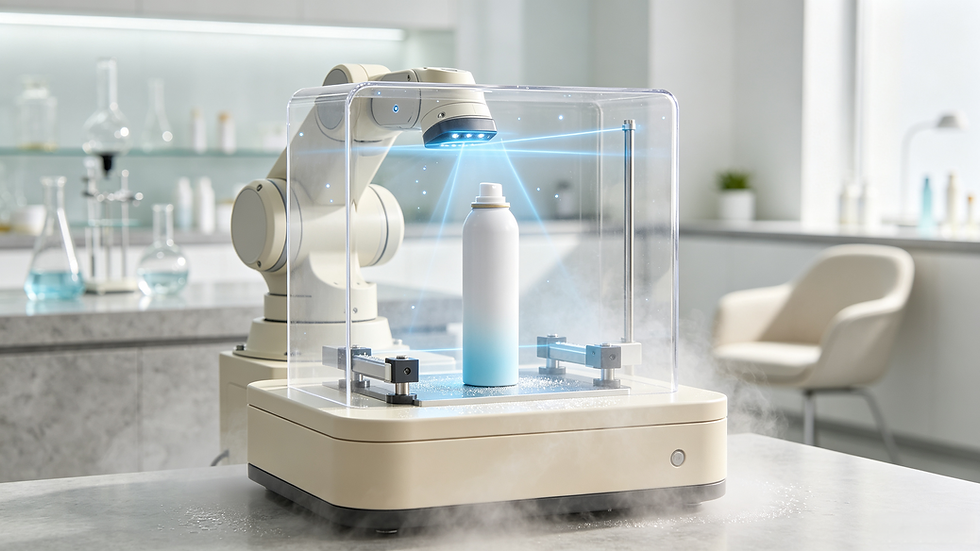
Pain Point Analysis: Why Traditional "Water Bath Leak Testing" is Failing on High-Speed Lines
The principle of traditional Water Bath Leak Testing is simple: seal the container, immerse it in water, apply pressure or vacuum, and rely on human eyes or simple visual sensors to observe escaping bubbles. However, in 2026's high-demand mass production, this "classical" method exposes three fatal dead ends:
Dead End 1: Micro-Leak Blind Spots and "False Negatives"
The physical limit of water bath testing is constrained by the surface tension of water. When the sealing gap of a valve or pump head is smaller than 20-50 micrometers (μm), water molecules form a liquid film at the gap, preventing internal gas from forming visible bubbles. This means a large number of defective products with "micro-leaks" will slip through the water bath test, only to cause disastrous leakage in the hands of consumers or during high-altitude, low-pressure transport.
Dead End 2: Secondary Contamination and Microbial Growth Risks
After water bath testing, the bottle body and valve must undergo a thorough drying process. This not only drastically increases the energy consumption and footprint of the production line, but more fatally, if drying is incomplete, residual moisture in the valve gaps or pump head dead corners becomes a breeding ground for microbes (such as Pseudomonas aeruginosa). This directly leads to microbial exceedance in the product, triggering severe compliance crises.
Dead End 3: Subjective Errors and Low OEE (Overall Equipment Effectiveness)
Manual visual inspection of bubbles is highly susceptible to visual fatigue. Meanwhile, automated optical inspection (AOI) in high-speed water baths often suffers from high "false rejection rates" due to water splashing, light refraction, or gas expansion interference caused by water temperature changes. To maintain yield rates, the production line is forced to slow down, severely dragging down overall OEE.
Tech Breakthroughs: The "Dimensional Strike" of Helium Mass Spectrometry and Vacuum Decay
To completely eliminate micro-leaks and adapt to high-speed production lines, modern, excellent contract manufacturers have fully introduced non-destructive automated leak testing solutions based on Tracer Gas and Pressure Decay.
Solution A: Helium Mass Spectrometry (Tracer Gas Leak Testing)
This is currently the "gold standard" for leak detection in aerosols and high-pressure sprays.
Engineering Logic: Helium (He) is the smallest, most penetrating inert gas in nature. During filling, we inject a trace amount of helium into the can (or mix it with the propellant). When the product enters the fully automated leak testing chamber, the chamber is pumped into a high vacuum. If there is even a tiny gap of 1 micrometer (μm) in the valve or can body, the extremely small helium atoms will instantly escape.
Precise Quantification: A high-precision Helium Mass Spectrometer can capture minute changes in helium concentration (with sensitivity reaching 10−610−6 to 10−910−9 mbar·l/s). The system not only intercepts 100% of defective products but also accurately quantifies the leak rate, providing real-time data feedback for the upstream capping/sealing process.
Solution B: Vacuum Decay Leak Testing
For non-aerosol premium vacuum pump bottles or tubes, vacuum decay is the most efficient non-destructive choice.
Engineering Logic: The product is placed in a custom test chamber and a vacuum is applied. If the packaging seal is intact, the chamber pressure remains stable. If a micro-leak exists, the air or gas phase inside the packaging is sucked out, causing a minute decay in the chamber's vacuum level.
Advantage: High-precision pressure sensors can capture pressure changes at the Pascal (Pa) level. It is completely non-destructive, requires no water, and the testing cycle takes only a few seconds, perfectly matching high-speed packaging lines.
Core Data Comparison: The Game of Interception Rate, False Rejection, and Line Efficiency
To intuitively demonstrate the technological generation gap, based on real production line data, we provide a multi-dimensional quantitative comparison between "Automated Negative Pressure Water Bath" and "Helium Mass Spectrometry / Vacuum Decay":
Evaluation Dimension | Automated Negative Pressure Water Bath | Helium Mass Spec / Vacuum Decay | Business & Engineering Impact |
Detection Limit | ~20 - 50 μm (Limited by water surface tension) | < 1 μm (Helium atomic penetration / Pa-level pressure sensing) | Helium mass spec intercepts "fatal micro-leaks" that cause high-altitude low-pressure leakage. |
Defect Interception Rate | 85% - 92% (Prone to missing micro-leaks) | > 99.99% (Absolute physical quantification) | Completely prevents micro-leaking products from entering the market, reducing complaint rates to near zero. |
False Rejection Rate | High (Water splashing, temp fluctuations cause misjudgment) | Extremely Low (< 0.1%) (Unaffected by external visual interference) | Drastically reduces the innocent scrapping of qualified products, directly recovering material costs. |
Secondary Contamination Risk | High (Requires washing/drying, prone to moisture residue) | Zero (Completely dry, non-destructive testing) | Eliminates microbial growth hazards, guaranteeing the product's sterile/low-bioburden state. |
Line Adaptation Speed | Slow (Requires soaking, holding, drying; typically <150 bottles/min) | Extremely Fast (Second-level cycle, adapts to 300-500+ bottles/min) | Removes the "bottleneck" of the leak testing process, maximizing line OEE and capacity. |
Data Traceability | Weak (Only records "Pass/Fail") | Strong (Records the specific leak rate value for each bottle) | Meets FDA MoCRA and EU digital traceability requirements for production deviations. |
Compliance Empowerment: Building the Global Logistics Safety Baseline with "Hardcore Interception Rates"
Under the increasingly stringent global dangerous goods transport regulations (such as IATA air transport and IMDG sea transport) in 2026, the anti-leak standards for aerosols and high-pressure sprays have been elevated to unprecedented heights.
1. Meeting Mandatory "Low-Pressure Leak-Proof" Requirements for Air/Sea Transport
The air pressure in an air freight cabin during cruising is equivalent to an altitude of 2000-2400 meters. The expansion of internal gas exerts a massive outward thrust on the valve. The "micron-level" interception capability of helium mass spectrometry ensures that the product maintains an absolute seal even in extreme low-pressure environments, helping brand owners smoothly obtain the "Air Transport Condition Appraisal Report" and smoothly navigate the global air transport network.
2. Establishing a "One Item, One Code" Quality Digital Twin
Advanced automated leak testing equipment is directly connected to the factory's MES (Manufacturing Execution System). For every product that passes the test, its specific leak rate value, test time, and equipment status are bound to a unique batch or bottle QR code. When facing unannounced inspections by overseas regulatory bodies or customer complaint investigations, brand owners can instantly pull up the "seal birth certificate" of that specific bottle, demonstrating impeccable quality governance capabilities.
Conclusion: Reshaping the Certainty of Packaging Integrity with Precision Instruments
The upgrade of "leak testing" automated solutions is not merely a change of QC tools; it is the ultimate defense of a contract manufacturer regarding brand reputation and supply chain safety. In the context of high-speed mass production and global expansion, replacing the macroscopic roughness of "water bath bubbling" with the microscopic quantification of "helium mass spectrometry/vacuum decay" is the only way for brand owners to avoid return disasters and reduce hidden losses.
Partner with Deva Skincare for Advanced Automated Leak Testing & Zero-Defect Packaging
Are you looking for a reliable skincare factory that guarantees the absolute sealing integrity of your aerosols, sprays, and vacuum packaging?
Are you seeking a trusted partner to launch or scale your product line with state-of-the-art, non-destructive leak detection technologies that eliminate micro-leaks and transit failures? At Deva Skincare, we have upgraded our quality control infrastructure with advanced Helium Mass Spectrometry and Vacuum Decay automated testing systems, moving far beyond the limitations of traditional water bath methods.
By collaborating with Deva Skincare, you gain access to industry-leading packaging integrity engineering, uncompromising automated QC, and a resilient supply chain that protects your brand from costly leakage complaints. Contact us today to discover how our advanced leak testing solutions can help you succeed.


Comments