From 3ml Sample to 50,000 Bottles: How Cosmetic OEMs Ensure Batch Consistency ≤5% Variation

Updated: May 9
Many brands face this nightmare: Your sample looks perfect—texture, color, fragrance all approved. But mass production delivers thinner consistency, yellowish color, or even separation. This means delayed launches and potential returns.
This article breaks down 4 critical control points from lab sampling to large-scale production, showing how cosmetic OEM maintain active ingredient variation within 5% and boost first-pass inspection rates from industry average 68% to 92%.

Why Samples and Mass Production Never Match?
The Core Problem: Lab ≠ Factory Floor
Mixing 100ml in a beaker versus producing 500L in an emulsification tank involves completely different physical conditions:
Variable | Sampling | Mass Production | Risk |
Shear Force | Magnetic stirrer 300rpm | Homogenizer 3000-5000rpm | Emulsion particle size variation |
Heating Rate | Water bath gradual heating | Steam jacket rapid heating | Heat-sensitive ingredient degradation |
Cooling Time | Natural cooling 2hrs | Circulating water 30min | Crystalline ingredient precipitation |

Real Case: A serum client used Vitamin E acetate. Lab added it drop by drop manually, but mass production injected it all at once via metering pump, causing local concentration spikes and flocculation after 7 days at 45°C acceleration test.
DEVA Skincare Solution: Simulate Mass Production from Day 1
From first sampling, we reverse-engineer lab processes based on production equipment parameters:
Use miniature high-shear emulsifiers (speed range covers 80%-120% of production equipment)
Record precise temperature-time curves, not just "heat to 80°C"
Apply pre-dilution method for trace ingredients to ensure uniform dispersion
Result: Internal data from 200+ formulas shows this method reduces adjustment rounds from 3.2 to 0.8 on average.
Active Ingredient Degradation: The Hidden Cost
The Pain Point: Efficacy Claims vs. Actual Content
2025 regulatory data shows 23% of non-compliant cosmetics stem from active ingredient content deviating >20% from label claims. Common degradation factors:
Oxidation: Vitamin C, polyphenols, unsaturated fatty acids
Hydrolysis: Peptides, certain ester preservatives
Photolysis: Retinol derivatives, some plant extracts
Thermal degradation: Probiotic ferments, enzymes

Three-Point Process Control
① Inert Gas Protection
Emulsification tanks equipped with nitrogen displacement, reducing oxygen concentration to <0.5% before production
Storage tanks and pipelines use positive pressure nitrogen sealing
Ideal for: High-concentration VC serums, astaxanthin creams, rosehip oil
② Low-Temperature Emulsification
Use cold process or low-temp emulsification (<45°C) for heat-sensitive ingredients
Replace traditional carbomer (requires neutralization heating) with low-temp thickeners
Case: 10% niacinamide serum reduced emulsification temp from 75°C to 50°C, improving retention rate from 82% to 96% after 3-month acceleration test
③ Online pH Monitoring
pH affects preservative efficacy, emulsion stability, active solubility
We install online pH electrodes with real-time data sync to control room
Alerts trigger automatically when deviation exceeds ±0.2
Standard Reference: Per China's Cosmetic Safety Technical Specifications (2025), labeled pH deviation must be ≤±1.0; our internal standard is ±0.5.
Packaging Compatibility: The 90% Overlooked Risk
Cosmetic OEM Typical Failure Case
A client chose PET bottles for high-concentration AHA serum (pH 3.5), using glass bottles for sampling. After 3 months of mass production:
Bottle interior fogging, transparency loss
Viscosity increased 15%
Third-party testing detected antimony migration (PET catalyst residue)
Root Cause: Acidic system accelerated PET hydrolysis, causing monomer and additive leaching.
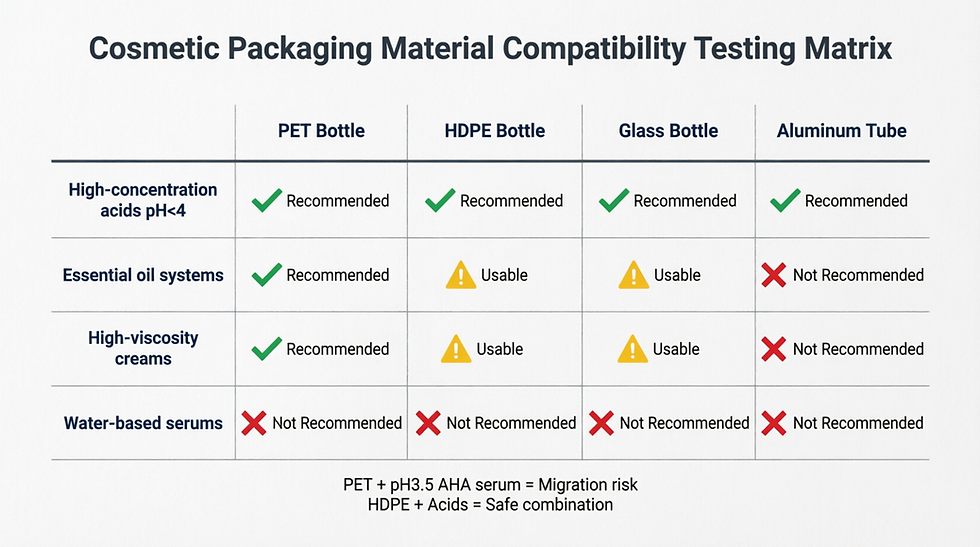
Our Packaging Evaluation Protocol
We initiate packaging compatibility testing before formula finalization:
Test | Condition | Duration | Pass Criteria |
Accelerated Stability | 45°C/75%RH | 3 months | No leakage, deformation, migration |
Temperature Cycling | -10°C↔45°C, 12hrs each | 10 cycles | No cracking, separation |
Content Immersion | 60°C accelerated | 30 days | GC-MS migration ≤0.1ppm |
Drop Test | 1.2m height, 6 faces | Once each | No breakage, leakage |
Packaging Database: We've built a 200+ packaging-formula matching database:
High-concentration acids (pH<4) → Recommend HDPE/Glass/Aluminum tubes
Essential oil/fragrance systems → Avoid PC material (stress cracking risk)
High-viscosity creams → Avoid narrow-mouth bottles (>15% filling residue)
Client Value: Identify packaging risks early, avoiding ¥50,000-100,000 mold losses.
Quantifying Batch Consistency
We use Critical Quality Attribute (CQA) monitoring, testing each batch against sample benchmarks:
Attribute | Method | Tolerance | Action if Exceeded |
Viscosity | Rotational viscometer (25°C) | ±10% | Adjust thickener dosage |
pH | Online electrode + lab verification | ±0.3 | Fine-tune with citric acid/NaOH |
Active Content | HPLC/GC | ±5% | Trace raw material batch |
Microbial | Total count/mold-yeast | Per Regulations | Isolate batch, investigate |
Particle Size | Laser diffraction | D90≤10μm | Check homogenizer gap/speed |
The Bottom Line: DEVA Skincare OEM is About Risk Management
Choosing an OEM isn't about finding someone 5% cheaper—it's about avoiding recalls, delays, and complaints.
Stability control from sampling to mass production reflects process scale-up capability, quality system maturity, and supply chain coordination. We've helped 47 brands launch from 0 to 1, achieving:
35% faster sampling-to-production cycles (90 days → 58 days)
92% first-pass rate (industry average: 68%)
0.3% complaint rate from batch variation (<1/300 batches)
Our R&D team and certified production facilities deliver turnkey OEM/ODM solutions tailored to your target market’s regulatory and consumer expectations.
By collaborating with Deva Skincare, you gain access to industry-leading expertise and innovative formulations that set your brand apart in the competitive global market. Contact us today to discover how we can help you succeed.


Comments