High SPF vs. Lightweight Feel: The Formulation Science Behind Getting Both Right

Updated: Sep 17
The Tension Every Sunscreen Brand Faces
Consumers are looking for sunscreens that protect, feel comfortable, and fit seamlessly into daily routines without compromising on skin health.
That sentence captures the entire challenge of high-SPF formulation in 2026. It sounds simple. It is not.
The physics of UV protection and the physics of a pleasant skin feel are fundamentally in opposition. Higher SPF requires more UV filter material on the skin. More material on the skin creates heavier textures, whiter cast, and stickier finishes. The brands that have solved this tension — and built loyal followings because of it — did not discover a magic ingredient. They made better formulation architecture decisions.
The global high-SPF sunscreen market is projected to reach $672.1 million, growing at a CAGR of 8.5% through 2033. The engine of that growth is not consumers accepting heavier sunscreens — it is consumers finally finding high-SPF products they are willing to wear daily. Understanding the formulation science behind that shift is essential for any brand entering or scaling in this category.
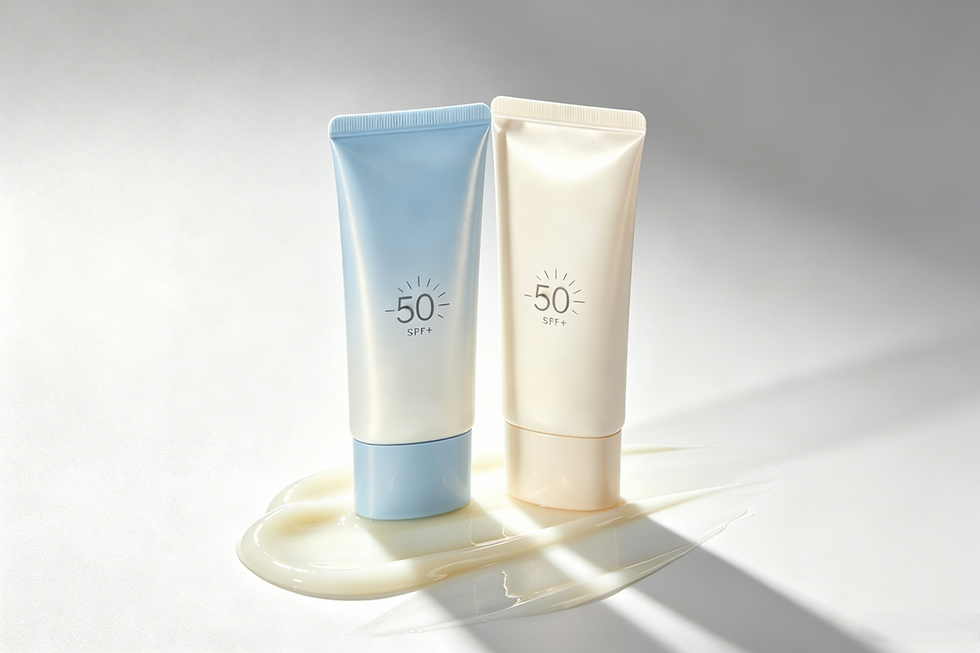
Part 1: Why High SPF and Lightweight Texture Are in Fundamental Conflict
The Load Problem
SPF is a measurement of UV-blocking capacity per unit area of skin. The fundamental equation is simple: achieving a high SPF, particularly broad-spectrum protection covering both UVA and UVB rays, often requires a high concentration of UV filters, which exacerbates textural and aesthetic issues.
Filter Type | The Physics Constraint | Texture Consequence |
Mineral (ZnO) | ZnO at 4–6% contributes SPF 15–25. To reach SPF 50 with ZnO alone requires 20%+ concentration. | Texture resembles white paste rather than a modern cosmetic product. |
Chemical (Organic) | Reaching SPF 50+ typically requires 15–25% total active UV filter concentration across multiple absorbers. | Many filters are oily liquids or waxy solids, creating the heavy, greasy "old sunscreen" feel. |
The practical implication: SPF 50+ formulations cannot achieve elegant texture through UV filter selection alone. The entire formulation architecture — base system, volatile carrier ratio, film-former, mattifying agents — must work together to compensate for the sensory burden of the UV filter load.
Part 2: The Five Formulation Levers for High SPF with Light Texture
Lever 1: Hybrid UV Filter Architecture — The Most Powerful Single Tool
The most efficient SPF-per-gram and texture-per-SPF ratio is achieved through strategic hybrid UV filter stacking:
UV Filter Role | Recommended Filter | SPF Contribution | Texture Impact |
UVB workhorse | Ethylhexyl methoxycinnamate (OMC) at 7.5% | SPF 15–20 | Slightly oily, medium impact |
UVA I coverage | Zinc oxide nano 4–5% (surface-modified) | SPF 5–8 + full UVA I | Low impact when nano-grade |
Broad-spectrum booster | Tinosorb S (EU/APAC) at 0.5–2% | SPF 10–15 | Minimal — highly efficient per gram |
Photostabilizer | Octocrylene at 2–5% | SPF 5–10 | Medium — reduces avobenzone load needed |
This architecture reaches SPF 50+ with a total active load approximately 40% lower than single-system approaches, directly reducing the sensory burden. Tinosorb S (Bis-Ethylhexyloxyphenol Methoxyphenyl Triazine) is particularly important here — it is among the most efficient UV absorbers available, delivering broad-spectrum coverage at concentrations where older-generation filters would need to be used at 5–10× higher levels.
⚠️ Note for US-Market Brands: Tinosorb S is not FDA-approved for OTC sunscreen drug products. For US distribution, this hybrid architecture requires a US-specific variant using avobenzone + octocrylene + OMC + nano-ZnO.
Lever 2: Volatile Silicone or Ester Carrier Systems — The Texture Game-Changer
The single most impactful decision for finished product texture is the choice between volatile and non-volatile base carriers.
Non-volatile esters/oils (isopropyl myristate, caprylic/capric triglyceride, mineral oil): Remain on skin after application, creating persistent greasy film.
Volatile carriers: Evaporate after application, leaving only the UV filter film and film-forming polymer network.
Volatile Carrier | Evaporation Profile | Post-Evaporation Feel | Regulatory Status |
Cyclopentasiloxane (D5) | ~25 seconds at 37°C | Dry, matte, weightless | EU leave-on limit 0.1% effective June 2026 |
Isododecane | Comparable rate to D5 | Dry, matte, weightless | No current restrictions; preferred global alternative |
The practical formulation approach for high-SPF lightweight products: 40–55% volatile carrier (isododecane ± low-level D5 where market allows) in a Si/W (silicone-in-water) or W/Si system. At this carrier ratio, the sensation difference between SPF 30 and SPF 70 from a consumer perspective is minimal — the UV filter concentration increase is masked by the dominant volatile-then-dry texture architecture.
Lever 3: Film-Former Selection — Dry Film, Not Residue
High-performance film-forming polymers serve a dual role in high-SPF formulations: they extend water resistance (keeping UV filters in place after perspiration) and they determine whether the post-evaporation feel is "second skin" or "plastic coating."
Positioning | Recommended Film-Former | Characteristics |
Lightweight / Daily Wear | VP/VA Copolymer (Vinylpyrrolidone/Vinyl Acetate) | Soft, flexible film with minimal tactile presence. Combined with volatile silicone, approaches imperceptibility. |
Sports / High Durability | Acrylates/Octylacrylamide Copolymer | Robust, water-resistant film with slightly more tactile presence. Acceptable for active consumers prioritizing staying-power. |
The 2026 innovation to watch: The anticipated 2026 introduction of Parsol Shield represents a structural shift for U.S. sunscreen innovation, marking the first new FDA-proposed UV filter in more than 25 years. The result is described as a breathable, daily-wear sunscreen with a non-tacky finish, designed to help meet both performance expectations and consumer demand for elegant, comfortable textures.
Lever 4: Mattifying Agent System — Active Sebum Management
High SPF formulas often use higher concentrations of film-forming polymers, which can leave a shiny or film-like finish even after volatile carriers evaporate. Mattifying agents address this and simultaneously solve the secondary problem of oil-skin consumers: midday shine.
Agent | Loading | Mechanism & Benefit |
Silica Microspheres | 1–3% | Porous structure provides ongoing sebum absorption (4–6 hours). Optical diffusion creates a "soft-focus" effect that visually blurs pores. |
PMMA Microspheres | 1–2% | Smooth, non-porous spheres reduce friction coefficient, improving spreadability during rub-in. Contributes to mattifying visual effect. |
Nylon-12 Powder | 1–2% | Fine, hydrophobic powder adheres to skin, creating a dry, velvet-texture finish. Excellent for high-humidity markets. |
Lever 5: Emulsion Architecture Optimization — Matching Structure to Sensory Brief
The emulsion type determines baseline texture before any specialty ingredients are added:
Emulsion Type | Architecture | Best For |
O/W (Oil-in-Water) | Low non-volatile oil phase; replace standard esters with lightweight esters (dicaprylyl carbonate, C12-15 alkyl benzoate). | Simplest architecture for lightweight feel. |
Si/W (Silicone-in-Water) | Isododecane/D5 as continuous phase with water droplets. Post-evaporation, water phase deposits actives without oil residue. | Best for "invisible" high-SPF formulas; requires specialized equipment. |
Anhydrous (Stick/Balm) | No water phase; UV filters dissolved in wax/oil matrix. | Sports/outdoor positioning where feel is secondary to performance. |
Part 3: The Consumer Communication Angle — Turning Formulation Science into Brand Messaging
Understanding the formulation science is only half the challenge for brand operators. The other half is translating technical decisions into consumer-facing messages that drive purchase intent.
Texture as Trust Signal
Consumers are increasingly looking for sunscreens that feel lightweight, non-greasy, and suitable for daily wear. For brand messaging, texture is not just a preference — it is a compliance driver. A product so pleasant to apply that people actually want to use it daily, and use enough of it, delivers more real-world sun protection than a technically superior formula that consumers avoid or ration.
This is the genuine intersection of formulation science and brand strategy: when your technical team delivers a high-SPF formula with genuinely imperceptible texture, your marketing team has a performance story ("SPF 70") and an experience story ("you'll actually want to wear it") that reinforce each other.
SPF 50 vs. SPF 70 vs. SPF 100: The Honest Numbers
Labeled SPF | Theoretical UVB blocked | At 50% of test dose (real-world) | At 25% of test dose (heavy under-application) |
SPF 30 | 96.7% | ~SPF 14–17 equivalent | ~SPF 7–9 equivalent |
SPF 50 | 98.0% | ~SPF 20–25 equivalent | ~SPF 11–14 equivalent |
SPF 70 | 98.6% | ~SPF 25–35 equivalent | ~SPF 14–19 equivalent |
SPF 100 | 99.0% | ~SPF 30–50 equivalent | ~SPF 20–28 equivalent |
The takeaway for brand positioning: SPF 50+ is the rational minimum for a premium daily sunscreen once real-world under-application is factored in. SPF 70–100 provides meaningful additional margin for high-exposure consumers and those who consistently under-apply — but the benefit curve flattens significantly above SPF 50 at any realistic application dose.
The claim on the label has to survive the stability test.
Brands specify an active for the story, then discover the story does not hold at month 24. We select the delivery system and the preservative compatibility together, so the claim is still true when the product is on shelf.
That is the gap between a marketing concept and a sellable formula — and it is closed in R&D, not in QC.
By collaborating with Explore our formulation and R&D capability you gain access to industry-leading expertise and innovative formulations that set your brand apart in the competitive global market. Tell us the claim and the target market; we will tell you what is achievable and what it costs.
Summary: The High-SPF Lightweight Formula Framework
Formulation Element | Lightweight-First Choice | High-Durability Choice |
UV filter architecture | Tinosorb S + nano-ZnO + OMC (EU/APAC) | ZnO + avobenzone + octocrylene + OMC (US) |
Volatile carrier | 45–55% isododecane (Si/W base) | 30–40% isododecane (W/O or O/W base) |
Film-former | VP/VA copolymer (soft film) | Acrylates/octylacrylamide copolymer |
Mattifying agent | Silica 1.5% + PMMA 1% | Nylon-12 2% + silica 1% |
Oil phase | Lightweight esters only (<8% total non-volatile) | Moderate esters + wax for water resistance |
Target consumer | Daily urban SPF habit-formers | Outdoor/sports/beach users |
Key claim | "Invisible protection, no white cast" | "Won't budge: sweat, swim, sun" |


Comments