Real-World Testing of Massage Oil Packaging Compatibility: Sealing and Light-Blocking Comparison of Glass Droppers vs. PET Pumps vs. Aluminum Bottles

Updated: Sep 17
When many clients develop massage oils, the first step is often looking at the formula, and the second step is looking at the packaging. In fact, from a factory's perspective, whether the packaging matches the formula is often more important than mere aesthetics. Because massage oils usually contain plant oils, essential oils, fragrance components, and sometimes active ingredients, these raw materials are relatively sensitive to light, air, and packaging materials.
If the packaging is chosen improperly, the product might not show any issues right after leaving the factory, but after a while, problems like oil leakage, odor changes, oxidation, inner wall residue, bottle clouding, or even packaging deformation may occur. Therefore, packaging selection for massage oils is not just about "putting it inside," but must be considered comprehensively from three aspects: sealing, light-blocking, and stability.
Why Are Massage Oils So Sensitive to Packaging?
Let's do a quick science popularization: massage oils are quite different from ordinary lotions and creams. They have a higher oil content and stronger fluidity, and many products add essential oils or other active oils. These types of ingredients are highly susceptible to external environmental influences.
Light can make certain oils more prone to oxidation.
Air entering the package makes the product more likely to develop off-odors.
Mismatched packaging materials can lead to issues like adsorption, permeation, or softening.
Therefore, when factories produce such products, they usually don't just look at whether the packaging looks good; they first judge whether it can "steadily protect the contents."
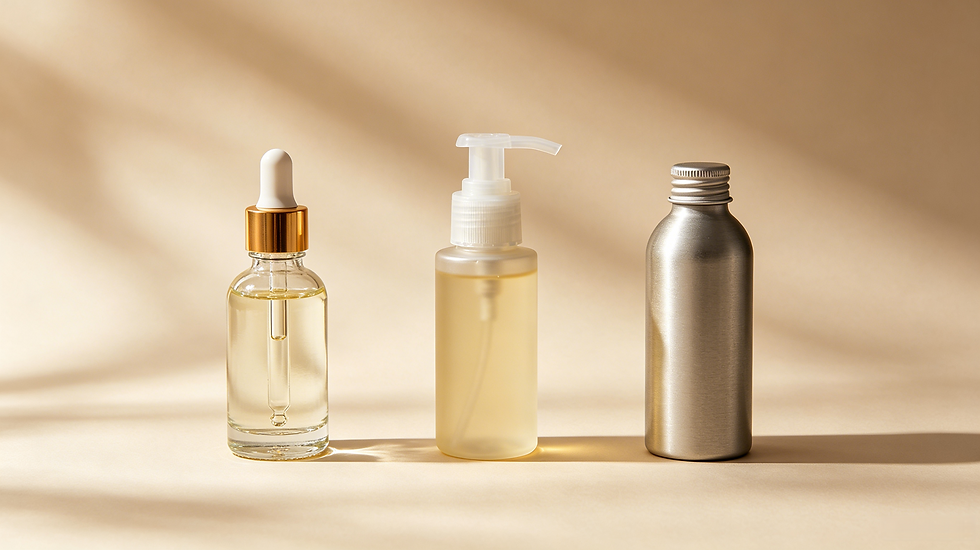
Glass Droppers: Suitable for High-End and Exquisite Products
Glass droppers are a very common packaging method for massage oils, especially suitable for high-end essential oils, repair-type massage oils, and gift box products. Its biggest advantages are: it looks premium, and glass itself is relatively stable, making it less likely to react significantly with oil-based contents.
From a scientific perspective, the chemical stability of glass is generally stronger than many plastic materials, so it provides more peace of mind when storing oil-based products. If paired with dark-colored glass (amber or cobalt blue), it can further reduce the impact of light on the contents, which is especially important for light-sensitive ingredients.
Limitations: However, glass droppers also have their limitations. For example, if the sealing structure of the dropper head, rubber bulb, and bottle neck threads is not optimal, oil leakage is prone to occur. Additionally, dropper products are more geared towards "targeted drop-by-drop application" and are not very suitable for scenarios requiring large-area application or quick dispensing. Another point is that while glass packaging is premium, it requires more attention to breakage prevention during transportation.
Suitable for which clients: If your product aims for a high-end, exquisite route, or mainly targets gift boxes, salons, and boutique channels, glass droppers would be a relatively suitable choice.
PET Pumps: Lightweight and Convenient, but More Suitable for Regular High-Volume Products
The characteristics of PET pumps are that they are lightweight, practical, cost-friendly, and more suitable for mass production. Many clients like them because they are light in hand, have relatively low transportation costs, and are convenient for users.
Limitations: However, from a scientific perspective, although PET material is widely used, its light-blocking ability is average. If the product itself is relatively sensitive to light, long-term use of transparent or light-colored packaging will increase the risk of oxidation. Additionally, since massage oils are high-oil systems, prolonged contact with the internal parts of the pump may also cause issues like backflow, pump jamming, or leakage.
In other words, PET pumps are more like an "efficiency-oriented solution." They are suitable for regular care, daily use, and high-volume products, but may not be the best choice for all highly active massage oils.
Suitable for which clients: If your product is positioned for mass consumption, standardized supply, cost control, and rapid market launch, PET pumps would be more appropriate.
Aluminum Bottles: Strong Protection, Suitable for Products Emphasizing Stability
The biggest advantage of aluminum bottles is: strong light-blocking, good protection, and relatively stable sealing. For massage oil products that emphasize preservation stability, moisture-proofing, and light-blocking, aluminum bottles have a clear advantage.
Limitations: In principle, metal packaging generally has stronger barrier capabilities against light and air, making it more suitable for products that are sensitive to oxidation and have high preservation condition requirements. For example, travel sizes, functional care products, and professional-line products are all very suitable for considering aluminum bottles.
But aluminum bottles also have their drawbacks. For instance, they don't look as exquisite as glass visually, and the user experience when opening and dispensing requires special design. If the inner coating is not properly treated, there may still be compatibility risks when in long-term contact with oil-based contents.
Suitable for which clients: If your product focuses more on protection, functionality, and a long shelf life, aluminum bottles are a solution worth considering.
How to Choose Among the Three Packaging Types to Make the Right Decision
From factory experience, there is no absolute "best" among the three packaging types, only the "most suitable."
Glass Droppers: Suitable for high-end, exquisite, and gift-box products.
PET Pumps: Suitable for high-volume, lightweight, and cost-control products.
Aluminum Bottles: Suitable for products with high protection requirements and an emphasis on stability.
Many clients tend to only look at the quotation when choosing packaging, but what truly affects subsequent sales is often the product's performance during use. For example, whether it leaks oil, changes odor, oxidizes, or is hard to press—these issues are all closely related to the packaging.
Therefore, we usually advise clients to test the packaging and formula together during the sampling stage, rather than starting to consider packaging only when the product is about to be finalized. Because once the packaging is chosen incorrectly, the cost and time to change it later will both increase.
Why Conduct Packaging Compatibility Testing?
Here is some additional science popularization: so-called packaging compatibility testing, simply put, is to see "whether the contents and the packaging can coexist peacefully in the long term."
During testing, factories usually focus on several key points:
Material Integrity: Whether the contents will cause the packaging to deform, soften, or crack.
Content Stability: Whether the packaging will cause the contents to change color, develop off-odors, or oxidize.
Long-Term Storage: Whether leakage, inner wall residue, or volatilization occurs after long-term storage.
Environmental Resilience: Whether stability remains normal under different environmental conditions (e.g., temperature fluctuations).
This test may seem like it takes a little extra time upfront, but it actually helps clients reduce later-stage risks in advance. Because for cosmetics, a truly stable product requires not only a good formula but also stable packaging.
Scaling up should not mean re-learning the formula.
The most expensive stage of a launch is usually the second trial — the one where a bench formula meets the filling line and the numbers move. We engineer for the line, not the beaker.
Packaging compatibility, stability and fill accuracy are validated before commercial scale rather than discovered during it.
By collaborating with Explore our skincare manufacturing capabilities you gain access to industry-leading expertise and innovative formulations that set your brand apart in the competitive global market. Share your target output and packaging format; we will confirm line feasibility before you commit.


Comments