Skincare Manufacturer MOQ: A Tiered OEM Guide for 2026

Most skincare manufacturer MOQ quotes arrive as one number with no context behind it. Here is ours in full: DEVA Skincare sets a standard minimum of 5,000 units per SKU, 10,000 units for aluminium cans, 50,000 pieces for sheet masks and 200,000 units for ampoules. The number you finally receive depends on five variables, and packaging usually decides more of it than the formula does.
This guide explains why the floor exists, how three formula tiers move it, and how to bring it down without weakening your compliance file.
Why Does Skincare Manufacturer MOQ Exist at All?
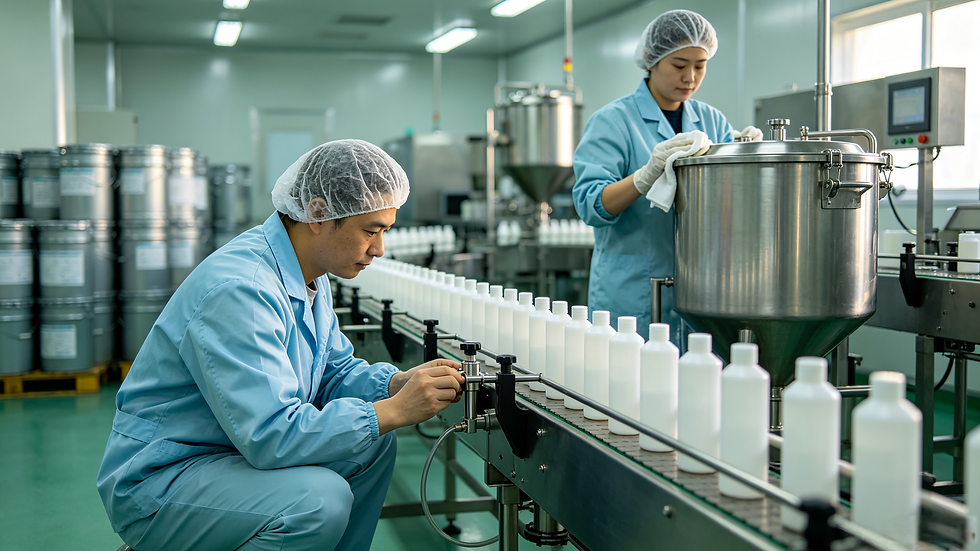
Every production run carries fixed costs that do not shrink when the order does. Cleaning, sanitising and setting up one filling line takes close to the same hours whether the batch fills 5,000 units or 50,000 units.
A skincare manufacturer MOQ marks the volume where one validated batch covers those fixed costs. Below it, fixed cost per unit climbs until the unit price stops working for both sides.
Three costs build most of that floor. Flushing and verifying a line consumes product, labour and machine hours. Release testing consumes samples and laboratory time. Raw materials arrive in supplier lots rather than in exact formula weights.
Scale helps, but it never removes fixed cost. DEVA Skincare runs four plants with combined capacity above 20 million units a month, and each line still needs its own changeover, cleaning record and batch release.
MOQ protects your launch too. A batch too small to sample, test and release properly ships on assumption, and one recall costs more than the units saved.
One clarification saves first-time buyers a week of confusion. The minimum is quoted per SKU, so one formula in one component counts as one SKU, and the same formula in a second component counts as another. Ask whether a quote is per SKU, per formula or per combined order before you compare offers.
Which Five Variables Move Your Minimum Order Quantity?
Five inputs set your minimum, and your real number equals the highest of them. Formula base, packaging format, line changeover, testing scope and regulatory filing each carry their own floor.
Variable | What drives its floor | How it appears in your quote | Can it be reduced? |
Formula base | Supplier lot sizes for actives and base materials | Minimum weight for one bulk | Yes, adopt a stock formula |
Packaging | Component minimums and decoration setup charges | Unit cost steps below supplier lots | Yes, use stock components |
Line changeover | Cleaning validation and first-flush product loss | Fixed setup cost per batch | Partly, share a production slot |
Testing | Protocols run per formula, not per unit | Fixed validation cost per batch | No, release testing is mandatory |
Product filing | Special cosmetic registration in China, MoCRA registration and listing for the US | Added timeline, not added volume | No, but existing filings help |
Formula comes first. Specialized systems arrive in supplier lot sizes, and amino acid surfactants cost more per kilogram than sulfates, driven by raw material cost. Adopting one of our 5,000+ proven formulas removes that exposure.
Packaging often sets the ceiling rather than the floor. Component suppliers hold their own minimums, and decoration steps such as silk-screen printing or hot stamping carry setup quantities larger than the filling minimum.
Changeover cost hides inside the unit price. Our plants follow 72 inspection and process control steps, and line cleaning plus verification around your batch is one of them.
Testing is fixed by protocol count, not by unit count. We hold 150 efficacy and safety test protocols, including cell testing, the CAM irritation assay, melanin inhibition and preservative challenge testing, and each applies regardless of batch size.
Filing adds time rather than volume. Whitening and sun protection products are registered as special cosmetics in China, where DEVA holds 22 special cosmetics certificates with 21 more in application. Products destined for the United States need MoCRA facility registration and product listing before they clear customs.
How Do the Three MOQ Tiers Compare?
MOQ rises with how much of the formula you change. Tier 1 ships a proven formula as documented, Tier 2 adjusts set parameters inside it, and Tier 3 builds a new architecture from raw materials upward.
Tier | What you change | Minimum driver | Testing scope | Best fit |
Tier 1: proven stock formula | Nothing. Formula ships as documented | Standard 5,000 units for most formats | Confirmatory safety and release testing | First launch and market test |
Tier 2: semi-custom base | Active level, fragrance, viscosity, sensory profile | Standard minimum plus one trial batch | Compatibility plus stability programme | Differentiation without full development |
Tier 3: full custom development | Formula architecture, actives, delivery system | Higher minimum plus development recovery | Full validation matrix | Proprietary platform and long-term IP |
Tier 1: proven stock formula
Tier 1 is the shortest route to a compliant first batch. The formula carries stability data already, so you skip development and move into sampling in about one week, then into mass production six weeks after sample approval.
The trade-off sits in differentiation. The composition belongs to the shared library rather than to your brand, so your positioning has to come from claims, texture, packaging and channel choice.
Tier 2: semi-custom base
Tier 2 changes defined parameters inside a proven architecture. Raising an active level, adjusting viscosity or rebalancing the fragrance changes performance, so the batch needs new compatibility data before release.
Two protocol sets apply here: multi-active compatibility testing, and formula plus stability testing. Each cycle runs about four weeks, and our team runs both in house.
Tier 3: full custom development
Tier 3 builds the formula from raw materials, and the validation matrix explains most of the added cost. A PhD-led R&D team owns the work, supported by 30+ formulation engineers and 70+ granted patents.
The full matrix covers an in-vitro efficacy panel, a 28-day human use test, residue quantification, TEWL plus texture imaging, multi-active compatibility, formula and stability testing, and SPF plus water resistance testing where the brief requires it. Each protocol runs about four weeks.
Tier 3 earns its higher minimum by producing something you own. The development record and validation data belong to your project, and later orders reuse the documented base.
Which Packaging Format Raises or Lowers Your Minimum?
Packaging moves your minimum faster than any other variable, because component suppliers set their own floors. The table below lists our actual MOQ by format, which most manufacturers decline to publish.
Format | DEVA MOQ | Why the floor sits there | Typical products |
Standard bottles, jars and tubes | 5,000 units | Baseline for one validated filling batch | Cleanser, toner, serum, cream |
Aluminium cans | 10,000 units | Can supplier lot sizes, dedicated filling heads | Foaming cleanser, mist, mousse |
Sheet masks | 50,000 pieces | Film and pouch conversion runs in long webs | Sheet mask, eye patch, lip mask |
Ampoules | 200,000 units | Dedicated workshop, four lines at 500,000 units per day | Single-dose concentrate ampoule |
Sheet masks consume film and trays that suppliers produce in long runs, so the material order sits above the filling volume most brands want. Ampoules run in a dedicated workshop, so one booking occupies equipment that could serve several larger batches.
Industry guides usually publish broad ranges: 500 to 5,000 units for private label, 20,000 to 30,000 pieces for sheet masks. One factory floor you can plan against beats a range you must interpret.
Standard formats remain the widest door. A stock bottle or tube keeps you at the 5,000-unit entry and leaves budget available for actives and testing.
Can a Startup Brand Order Below MOQ? Four Trial Paths
Start on a proven formula. A stock formula with stock components keeps you at the 5,000-unit entry and compresses the calendar, because one week of sampling and existing stability data replace development work.
Ask whether one bulk can carry several variants. One homogeneous bulk can often be filled as two or three fragrance or shade variants, so the total reaches the batch minimum while your commitment per SKU falls. Confirm this before locking artwork.
Accept a setup-inclusive unit price. Manufacturers sometimes accept a shorter batch when the unit price carries the fixed setup cost. This suits high-margin formats and pre-launch programmes rather than price-led retail listings.
Concentrate the first drop on one hero SKU. Each extra SKU brings its own changeover, release testing and filing. Client star SKU rate reached 28 percent and SKU reorder rate 35 percent, and both reward scaling one proven product first.
What Are Five Legitimate Ways to Lower Skincare Manufacturer MOQ, and What Do They Cost?
Every lever that lowers MOQ charges you somewhere else. The five levers below are the ones we can deliver, and each names its price, because a reduction offered without a cost usually reappears in your unit price.
Method | How it works | What it costs you | Works best for |
Adopt a stock formula | Use one of 5,000+ proven formulas | Composition stays shared | Launch speed, market test |
Use stock components | Skip custom moulds, colours and decoration | Weaker shelf differentiation | New and ecommerce-first brands |
Pay a setup-inclusive unit price | Carry fixed batch cost in unit price | Lower gross margin per unit | Premium, high-margin formats |
Reduce SKU count in the drop | One hero SKU instead of three scaled-down SKUs | Narrower first range | Validation launches |
Consolidate variants or commit repeats | Fill variants from one bulk, commit to reorders | Less freedom mid-cycle | Brands with forecast visibility |
Sequence matters more than choice. Locking packaging before you confirm the formula removes the cheapest lever first, so agree the component plan and the formula route in the same conversation, then ask for quotes at two volume bands.
How Does MOQ Change Your Unit Price?
Unit cost falls steeply at first and then flattens. Most of the drop happens between the standard minimum and roughly three times that volume; beyond that point, component purchasing lots and freight shape the price more than filling efficiency does.
MOQ band | What drives unit cost here | Relative unit cost | Practical note |
At the standard minimum, for example 5,000 units | Setup, cleaning and release testing spread over the fewest units | Highest | Best for validation, weakest for margin |
Around 2x the minimum | The same fixed cost spread over double the units | Clearly lower | Where most first reorders land |
Around 5x the minimum | Component supplier tiers and longer runs improve | Lower, curve flattening | Typical reorder level for a proven SKU |
Full-line or full-container volumes | Freight, purchasing and scheduling dominate | Lowest practical band | Suits established SKUs with stable demand |
Keep per-SKU minimums and total order value as two separate questions. Ten thousand units split across two SKUs costs more per unit than ten thousand units of one SKU, because each run carries its own changeover, its own cleaning validation and its own batch release documentation.
We deliberately avoid publishing percentage discounts here. The real delta depends on fill weight, viscosity, component choice and the test scope your market requires, so the honest answer arrives with your own bill of materials. Ask for quotes at two or three volume bands and compare them side by side.
How Do MOQ Choices Affect Sampling, Testing and Time to Market?
MOQ decisions are calendar decisions. Your tier and your packaging format decide which protocols run, and those protocols move in weeks rather than days.
Stage | Duration | Applies to | Note |
Formula selection and sampling | 1 week | All projects | Shorter from a proven formula |
In-vitro efficacy panel | 4 weeks | Tier 2, Tier 3 | Cell efficacy and toxicity testing |
28-day human use test | 4 weeks | Tier 2, Tier 3 | Supports performance claims |
Residue quantification | 4 weeks | New line setups | Cleaning validation |
TEWL plus texture imaging | 4 weeks | Barrier or sensory claims | VISIA covers 12 metrics |
Multi-active compatibility | 4 weeks | Tier 2, Tier 3 | Several actives in one base |
Formula and stability testing | 4 weeks | Any new or changed formula | Core requirement |
SPF plus water resistance | 4 weeks | Sun care | Includes water resistance |
Mass production after sample approval | 6 weeks | All projects | Booked by slot |
Running these protocols in house removes third-party queue time from your calendar. Our laboratory operates to CNAS standards and our cleanrooms run at the 100,000-grade GMPC level, so testing, filling and release share one schedule.
Bring three things to the enquiry form below: your category, whether that is facial moisturiser, sun care, baby care or ampoule serum, your formula route across stock, semi-custom or custom, and the skincare manufacturer MOQ you have budgeted for. We return a costed proposal with the component plan and the next available production slot.
What is the standard skincare manufacturer MOQ for private label?
DEVA Skincare sets a standard minimum of 5,000 units per SKU for most skincare formats. Aluminium cans start at 10,000 units, sheet masks at 50,000 pieces and ampoules at 200,000 units. Your final number depends on the formula route, the component choice and the validation scope for your target market.
Why is the minimum order quantity for private label skincare higher for sheet masks?
Sheet mask minimums sit higher because of material conversion rather than filling complexity. Film webs, trays and pouch laminates are produced in long runs by suppliers, so one material order covers far more pieces than most brands want for a first launch. Mask filling also runs on dedicated sealing equipment.
Can I lower MOQ if I use stock packaging?
Yes. Stock components remove the supplier lot sizes and decoration setup charges that usually sit above the filling minimum. A standard bottle, jar or tube typically keeps you at the 5,000-unit entry, while custom moulds, bespoke colours or silk-screen printing push the practical minimum higher.
How long does production take after sample approval?
Mass production takes about six weeks after you approve samples. Sampling itself takes about one week, and each validation protocol takes about four weeks, including stability testing, compatibility testing and, for sun care, SPF plus water resistance testing. We confirm a dated schedule once your brief is locked.
Does a custom formulation always mean a higher MOQ?
A custom formulation raises the minimum because development and the full validation matrix have to be recovered across the first batch. The alternative is a semi-custom route, where you change defined parameters such as active level, viscosity or fragrance inside a proven base, which keeps you closer to the standard minimum.
Which tests run before the first mass production batch?
Every new or changed formula goes through formula and stability testing. Tier 2 and Tier 3 projects add multi-active compatibility testing, an in-vitro efficacy panel and a 28-day human use test. Sun care adds SPF plus water resistance testing, and any new line setup adds residue quantification for cleaning validation. Each protocol runs about four weeks.
What is the MOQ for aluminium cans and ampoules?
Aluminium cans start at 10,000 units because can suppliers hold lot sizes and the format needs dedicated filling heads. Ampoules start at 200,000 units because they run in a dedicated pharmaceutical-grade workshop with four lines producing 500,000 units per day, and one booking reserves equipment that would otherwise serve larger runs.
Comments