The Carrier Design of Multi-Masking: Dual-Layer Substrate Composite Engineering for T-Zone Oil Control and U-Zone Hydration

Updated: Sep 17
In the 2026 global wave of refined skincare, "Multi-masking" or "Zone-targeted Masking" has evolved from a social media novelty into a standard category for high-end skincare lines. However, when developing such products, many brand owners only stay at the superficial logic of "zoning the serum formulas," neglecting the physical cornerstone that determines the product's success or failure: the zonal adaptation and composite engineering of the carrier substrate.
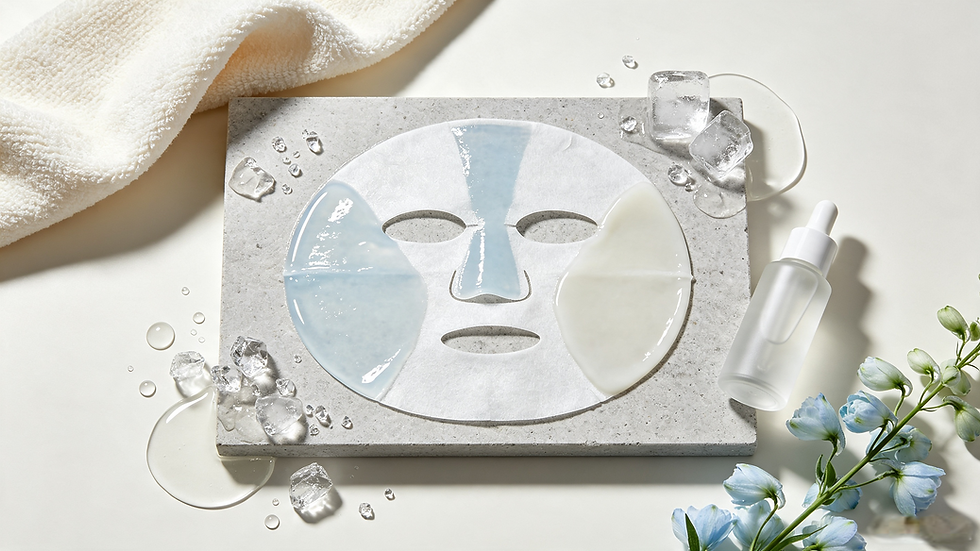
The fatal pain point of traditional single-piece sheet masks is: the T-zone (forehead, nose wings), due to dense sebaceous glands, is extremely prone to clogged pores and acne after masking; while the U-zone (cheeks), with sparse sebaceous glands, remains dry and tight after masking. As a professional cosmetics OEM/ODM factory, we know deeply that a true multi-masking product must be a "dual-layer substrate composite engineering" project based on skin physiology and material fluid dynamics. Today, starting from verifiable dermatological data, we will deeply dissect how to create a perfect zone-targeted skincare experience through the precise matching of substrates and serums in Zone-Targeted Mask Substrate Engineering.
I. Scientific Root Causes: The "Sebum Gland Density" Chasm in the Facial Microenvironment
To design zonal carriers, we must confront the massive physiological differences in the facial skin microenvironment.
According to anatomical data from authoritative dermatological journals such as the Journal of Investigative Dermatology, the distribution of sebaceous glands on the human face presents extreme "polarization":
T-Zone (Nose and Forehead): The sebum gland density is as high as 400 - 800 glands/cm², making it the hardest hit area for facial oiliness, enlarged pores, and blackheads. This area requires "high-porosity adsorption" and "corneous duct unclogging."
U-Zone (Cheeks): The sebum gland density drops sharply to 100 - 200 glands/cm². The barrier is relatively weak and highly susceptible to environmental humidity, leading to water loss. This area requires "highly occlusive hydration" and "deep barrier repair."
Using the same mask sheet and the same serum to cover the entire face will inevitably lead to the awkward situation of "T-zone getting too oily and acne-prone, while U-zone lacks sufficient hydration," highlighting the necessity of Zone-Targeted Mask Substrate Engineering.
II. Carrier Engineering Breakthroughs: "Fluid Dynamics" and "Transdermal" Matching of Dual-Layer Substrates
In OEM/ODM development, we achieve true targeted skincare through three major strategies: "zonal substrate customization + precise serum loading + seamless composite technology."
Strategy 1: T-Zone Carrier — High-Porosity Adsorption and Oil Control/Unclogging
Substrate Selection: We use micro-porous bamboo charcoal fiber or high-porosity Tencel™. These materials have developed micro-porous structures and large specific surface areas, acting like a "magnet" to adsorb excess sebum secreted in the T-zone.
Serum Loading: We compound low-concentration Salicylic Acid (BHA) or oil-control plant extracts. The strong adsorption capacity of the substrate delays the evaporation of the oil-control essence, allowing it to stay in the T-zone longer to exert its pore-unclogging efficacy.
Strategy 2: U-Zone Carrier — High-Occlusive Hydration and Rare Microalgae Repair
Substrate Selection: We use nanoscale Bio-cellulose or high-GSM Cupro. Its dense 3D mesh structure generates strong capillary pressure, locking in high-concentration moisturizing essences and forcefully opening the stratum corneum channels through the Occlusion Effect.
Serum Loading & Factory Core Barrier: In the U-zone essence, we exclusively introduce a rare ingredient jointly developed by Natural New Materials and the Shennongjia Natural Beauty Raw Material Research Institute—the Shennongxian Algae® Activating Factor (Nostoc sphaeroides extract).
Real Data Support: Third-party reports show that after 2 hours of using a solution containing 1% Shennongxian Algae® Activating Factor, the water content of the subjects' stratum corneum significantly increased by 22.55%; meanwhile, its inhibition rate of elastase reached 20.99±11.75%, demonstrating excellent moisturizing and firming/anti-wrinkle efficacy.
Formulation Advantage: Its INCI composition (including Butylene Glycol, 1,2-Hexanediol, Hydroxyacetophenone) comes with a gentle polyol self-preserving system, perfectly meeting the "traditional preservative-free" demand of the fragile U-zone skin, achieving dual empowerment of deep hydration and barrier repair in Zone-Targeted Mask Substrate Engineering.
Strategy 3: Dual-Layer Composite Technology — Rejecting Chemical Glue for "Physical Stitching"
Engineering Solution: We abandon allergy-prone chemical adhesives and adopt Ultrasonic Welding or high-pressure waterjet physical entanglement technology to molecularly fuse the two different substrates of the T-zone and U-zone at the junction (e.g., the cheekbone line). This ensures the mask sheet does not delaminate or fall off in a wet state, and has no chemical residue irritation.
III. Manufacturing & QC Challenges: The "Engineering Barriers" of Composite Substrates
The mass production of multi-masking products poses extreme challenges to a contract manufacturer's dimensional control and fluid dynamics management.
Challenge 1: "Wrinkling and Delamination" Caused by Differences in Wet/Dry State Expansion Rates
The volume expansion rates of the T-zone (e.g., bamboo charcoal) and U-zone (e.g., bio-cellulose) after absorbing the essence are completely different. If not calculated properly, the junction will severely wrinkle or tear during application.
QC Countermeasure: In our constant temperature and humidity workshop, we perform pre-shrinkage water treatment and wet/dry state dimensional tolerance modeling on both substrates. Through laser die-cutting (precision ±0.1mm), we precisely reserve expansion margins to ensure the mask sheet lies as flat as paper on the face.
Challenge 2: The "Capillary Cross-Zone" Effect of the Essence
High-aqueous essences easily flow from the U-zone to the T-zone via the capillary action of the mask fibers through "siphoning," leading to the failure of zoning.
QC Countermeasure: At the physical junction of the T-zone and U-zone, we implant a Hydrophobic Barrier about 3mm wide, or use a dual-chamber independent filling mold to physically isolate the essences inside the packaging, completely eliminating the risk of "cross-zone contamination" in Zone-Targeted Mask Substrate Engineering.
IV. Validation Pathway: The Rigorous Closed Loop from Transdermal Absorption to In-Vivo Efficacy
In the highly rational international B2B supply chain, "zonal efficacy" must rely on objective instrumental validation. We have established an exclusive validation closed loop:
Zone-specific Instrumental Testing
After subjects apply the multi-mask for 15 minutes, we immediately use a Sebumeter® to detect the sebum reduction rate in the T-zone (must be > 30%), while using a Corneometer® to detect the hydration increase rate in the U-zone (must be > 40%). Hardcore data proves "T-zone truly controls oil, U-zone truly hydrates."
SEM (Scanning Electron Microscope) Interface Analysis
We conduct microscopic morphological observations on the junction of the composite mask sheet to verify the fiber entanglement depth of the ultrasonic/hydroentanglement composite process, ensuring its physical bonding strength under tension and wet conditions.
Carrier Design Conclusion: Reshaping the Category Standard of "Multi-Masking" with Material Science
The carrier design of "multi-masking" reveals the profound evolution of modern cosmetic R&D from "single formulation" to the three-dimensional synergy of "carrier-formulation-physiology." Through the seamless composite of high-porosity adsorption substrates and high-occlusive hydration substrates, combined with the precise loading of rare microalgae ingredients, we have completely shattered the experience pain point of traditional sheet masks "attending to one thing and losing another." Mastering this underlying composite engineering capability is the only way for brand owners to build a solid technical moat in the red ocean of refined skincare through advanced Zone-Targeted Mask Substrate Engineering.
🤝 Partner with Deva Skincare for Next-Generation Multi-Masking Solutions
Are you looking for a reliable skincare factory? Are you seeking a trusted partner to launch or scale your innovative sheet mask line?
At Deva Skincare, we specialize in developing safe, high-efficacy formulations paired with advanced substrate engineering. That is how a concept reaches compliant, repeatable production without a mid-project supplier change.
We possess deep expertise in multi-zone mask engineering, including dual-material ultrasonic bonding, capillary flow control, and the integration of rare, clinically validated actives like Shennongxian Algae Activating Factor. We ensure your multi-masking products deliver scientifically proven, targeted efficacy for both T-zone and U-zone, free from cross-contamination or delamination risks.
Browse comparable products we already deliver: Explore our skincare manufacturing capabilities. Contact us today to discover how our advanced material science approach can help you succeed.


Comments