The Cost-Reduction Logic of Substrate Substitution: Replacing Imported Cupro with Domestic Lyocell for a 15% Cost Saving Without Compromising Experience

Updated: Sep 17
In the fiercely competitive 2026 global sheet mask market, brand owners face a dual pressure: rising raw material and logistics costs are squeezing profit margins, while consumer demands for "skin feel" and "conformability" are becoming increasingly stringent. When seeking to reduce Bill of Materials (BOM) costs, many brands fall into the trap of "cost-cutting equals quality-cutting," leading to skyrocketing customer complaint rates.
As a professional cosmetics OEM/ODM factory, we know deeply that true cost reduction is not about cutting corners; it is about "precise substitution" based on material science. Today, starting from verifiable physical data and supply chain logic, we will deeply dissect how replacing traditional imported "silk" (Cupro) with high-quality domestic Tencel™ (Lyocell fiber) can achieve a 15% comprehensive cost reduction while not only maintaining the experience but actually improving essence release rates and environmental sustainability.
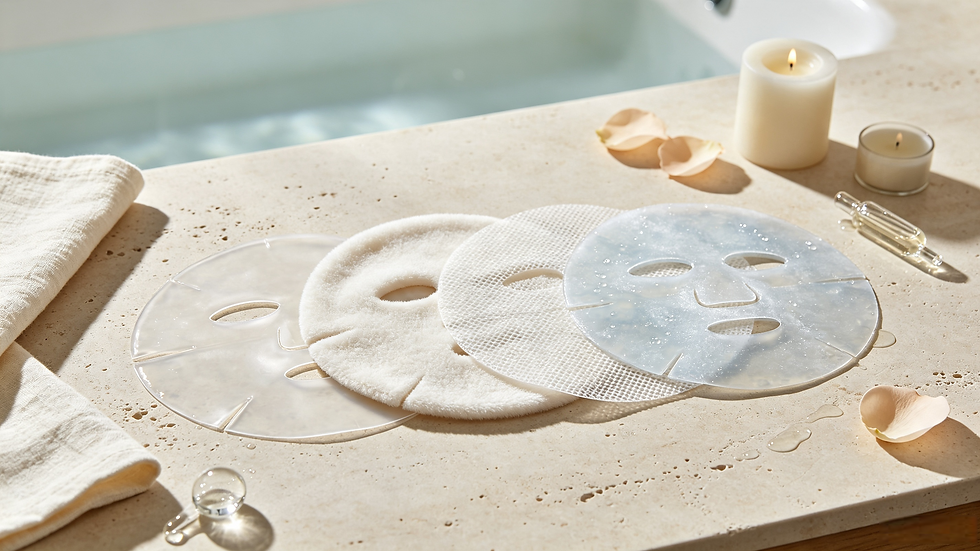
I. The Industry Truth: Unveiling the Physical Reality and Cost Premium of "Silk" Masks
First, we must clarify an industry fact: 99% of masks marketed as "silk masks" do not use actual silk protein fibers (which are prohibitively expensive and prone to spoilage), but rather Cupro (Cuprammonium rayon, such as Japan's Asahi Kasei Bemberg™).
Physical Characteristics: Cupro does possess an extremely fine fiber diameter (approx. 0.01 mm), providing an excellent "invisible, second-skin" feel and high transparency.
Cost Pain Points: Due to the complex cuprammonium production process, high environmental treatment costs, and heavy reliance on imports, its bulk procurement price remains persistently high. Furthermore, Cupro experiences a notable drop in tensile strength when wet, leading to higher breakage rates during die-cutting and automated packaging, which further drives up hidden costs.
II. Scientific Benchmarking: Why Domestic Lyocell is the "Perfect Alternative"
High-quality domestic Lyocell fiber (produced by top-tier manufacturers using a closed-loop solvent spinning process) matches or even surpasses traditional Cupro in multiple key physical metrics, making it the premier choice for high cost-performance.
Based on the latest 2026 Technical Data Sheets (TDS) from mainstream fiber suppliers (like Lenzing and leading domestic Lyocell producers) and laboratory empirical data:
Absorption and Release Capability (Core Experience): Lyocell fibers possess a unique microfibrillation structure, covered in microscopic fibrils. Its moisture regain is as high as 11% - 13% (superior to cotton's 8% and Cupro's 11%). Empirical tests show that at the same grammage (e.g., 25 gsm), Lyocell mask sheets can absorb 10 to 15 times their weight in essence. During application, its micro-capillary network efficiently releases > 90% of the essence onto the skin surface with zero residual feel.
Wet Strength and Flexibility: Lyocell exhibits minimal difference between dry and wet strength. Its elongation at break remains above 15% - 20% even in a wet state, ensuring the mask retains excellent tensile resistance after absorbing high-concentration essences. It resists tearing when applied to complex contours like the nose wings and eye area.
Skin Feel and Safety: The surface is smooth and soft with a low coefficient of friction, making it extremely friendly to sensitive skin. The production process leaves no harmful chemical residues, and the material is 100% biodegradable.
III. The 15% Cost Reduction Breakdown: The Real Path to Savings
How does switching from imported Cupro to domestic high-quality Lyocell achieve a 15% comprehensive cost reduction? This is not a single-dimensional price cut, but a systemic supply chain optimization:
Direct Raw Material Price Gap (Approx. 8% - 10%): The domestic Lyocell supply chain is highly mature. Scaled production makes its unit price significantly lower than imported Cupro, while also eliminating high cross-border logistics and tariff costs.
Improved Die-Cutting Yield (Approx. 3% - 4%): Lyocell’s wet-state strength is more stable. During high-speed automated folding and pouching, its superior tear resistance drastically reduces mask breakage and scrap rates, significantly lowering hidden loss costs.
Formulation Synergy Optimization (Approx. 2% - 3%): Lyocell’s high release rate means brands no longer need to over-fill the essence to compensate for "essence trapped in the mask." While maintaining the consumer’s perceived volume, the single-piece filling weight can be slightly optimized, further saving on high-value active ingredients.
IV. Formulation Synergy Engineering: Rheological Fine-Tuning Post-Substitution
A change in substrate must be accompanied by fine-tuning of the formulation to ensure a "1+1>2" experience. Lyocell absorbs liquid extremely quickly. If the essence is too thin, it will drip when the pouch is opened; if it is too viscous, it cannot leverage Lyocell's micro-capillary release advantage.
Engineering Countermeasure: Building a "Shear-Thinning" Matrix We recommend adjusting the essence's rheological properties to a shear-thinning (pseudoplastic) fluid. By compounding specific grades of Acrylates/C10-30 Alkyl Acrylate Crosspolymer, the essence maintains a higher viscosity at rest (inside the pouch) to prevent dripping. When the consumer unfolds the mask and applies slight pressure (generating shear force), the viscosity drops instantly. The essence is rapidly captured by Lyocell's microporous structure and distributed evenly, achieving "instant conformity, no dripping" upon application.
(Added Value): If your mask features high-efficacy actives (such as the rare Shennongxian Algae® Activating Factor), Lyocell’s extremely low active adsorption rate (< 5%) ensures these expensive small-molecule polysaccharides and phycocyanins are maximally released to the skin, maximizing overall ROI.
V. The Validation Pathway: Proving "Enhanced Experience" with Instrumental Data
In B2B collaborations, words are not enough; we must prove the reliability of the substitution with objective data:
Essence Release Rate Quantitative Test: Lyocell and Cupro masks saturated with 25g of essence are placed on a standard hydrophobic plate under 50g/cm² pressure to simulate a 15-minute application. After removal and weighing, the Lyocell mask’s essence release rate consistently stabilizes at 90% - 95%, matching or slightly exceeding Cupro.
Tekscan Facial Pressure Distribution Test: Using a flexible pressure sensor matrix system on a 3D facial model, data shows that high-quality Lyocell masks, due to their excellent extensibility, achieve an effective facial contact area of > 85% with uniform pressure distribution and no local suspension, perfectly replicating the "invisible conformity" of Cupro. Freeze-Thaw Stability Test: Verifying that the Lyocell mask, combined with the new formulation, shows no syneresis, phase separation, or hardening in environments ranging from -15°C to 45°C, ensuring global supply chain stability.
Conclusion: Reshaping the Supply Chain's "Cost-Performance" Baseline with Material Science
"Substrate substitution" is never a simple low-price swap; it is a systemic engineering project based on rheology, material physics, and supply chain optimization. By introducing high-quality domestic Lyocell, paired with precise formulation fine-tuning and rigorous instrumental validation, we have successfully shattered the industry myth that "imported equals premium, and cost-cutting equals quality-cutting."
Mastering this substrate substitution and synergistic engineering capability not only helps brand owners protect a 15% profit margin in fierce price wars but also wins long-term consumer favor in the international market with the new selling points of "eco-friendly, highly efficient, and high-release."
🤝 Partner with Deva Skincare for Cost-Effective & High-Performance Mask Solutions
Scaling up should not mean re-learning the formula. Are you seeking a trusted partner to optimize your sheet mask BOM costs without sacrificing quality?
At Deva Skincare, we specialize in developing safe, high-efficacy formulations paired with scientifically validated, cost-effective substrates. Packaging compatibility, stability and fill accuracy are validated before commercial scale rather than discovered during it.
We possess deep expertise in substrate substitution engineering, including precise rheology adjustment for Lyocell fibers, rigorous release rate validation, and Tekscan conformability testing. We ensure your masks deliver the premium "second-skin" experience of traditional Cupro, but with a 15% lower cost and a superior eco-friendly profile.
By collaborating with Deva Skincare, you gain access to industry-leading supply chain optimization and innovative formulations that set your brand apart in the competitive global market. Contact us today to discover how our advanced material science approach can help you succeed.


Comments