The Emulsification Challenge of "Hand Cream Water Separation": How to Prevent Oil-Water Separation During Cold Storage?

Updated: Sep 17
In Nordic winters, hand creams endure overnight freezing temperatures in delivery trucks. In warehouses in northern China, products spend entire winters in unheated storage facilities. These real logistics scenarios are quietly testing the "cold resistance" of every hand cream formula.
When brand owners first encounter "product water separation" complaints, their first reaction is often to suspect quality issues in the production process. But in fact, the true root cause of this phenomenon often lies not on the production line, but in the low-temperature transportation or storage process the product experiences after leaving the factory. Today, from the perspective of formulation science, we will completely deconstruct the causes and solutions for this typical emulsification challenge of "cold-temperature water separation."
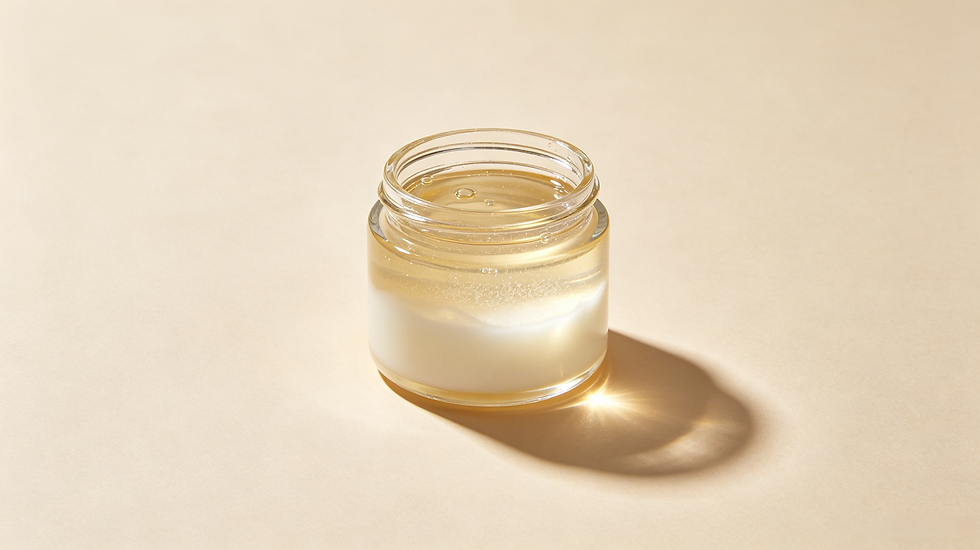
I. First Understand a Counter-Intuitive Truth: Emulsion Systems Are Inherently "Unstable"
To understand the "water separation" problem, we must first overturn a common cognitive misconception—many people assume that if a formula is well-made, the emulsion system should be "permanently stable." But the underlying logic of formulation science tells us the exact opposite.
Emulsion systems are considered thermodynamically metastable systems, meaning they can exist in a "long-lived state" that is not their most stable form. In fact, Gibbs once noted regarding emulsion system stability: "The only moment an emulsion system is truly stable is when it has completely separated." In the real world, this means emulsion systems always have a tendency to separate back into oil and water phases, even though viscosity and stabilizing ingredients can delay this separation process.
This passage reveals a core philosophy of formulation science—from the moment any emulsion system is born, it is fighting against its ultimate destiny of "separation." The formulator's job has never been to make separation "never happen," but to use a sufficiently long time window to slow down the separation process as much as possible, keeping the product stable and uniform in appearance and texture within a reasonable shelf life and under reasonable storage and transportation conditions.
Understanding this, the phenomenon that "low-temperature environments accelerate water separation" has a scientifically reasonable explanation—low temperature is precisely one of the key external variables that can trigger or accelerate the emulsion system's journey toward its "final stable state (i.e., separation)."
II. Why Does Low Temperature "Accelerate Water Separation"? — Three Microscopic Mechanisms
After understanding the inherent fragility of emulsion systems, let's examine the specific pathways through which low-temperature environments destroy hand cream emulsion structures.
Mechanism 1: Uncontrolled Crystallization of Waxes and Fatty Alcohols
The cooling phase is often underestimated—rapid or uneven cooling can cause abnormal crystallization processes in waxes and fatty alcohols, leading to structural weaknesses. If stirring is stopped too early during cooling, the emulsion system may collapse before it has fully set. Controlled cooling combined with continuous gentle stirring helps lock in a stable structure.
This mechanism reveals easily overlooked production process details in formulation design—the wax components commonly used in hand cream formulas (such as beeswax, cetyl alcohol, cetearyl alcohol, etc.) are highly sensitive to the rate of temperature changes during their crystallization process. If the low-temperature environment the product experiences after leaving the factory causes these wax components to recrystallize in an uncontrolled manner, the originally uniform and stable internal network structure may be disrupted, triggering visible phase separation.
Mechanism 2: Critical Balance of Emulsifier Concentration and Viscosity Modifiers
Insufficient or excessive emulsifier dosage both lead to cream instability—insufficient dosage cannot fully encapsulate droplets, while excessive dosage may disrupt internal structures. Standard low-speed mixing processes are often insufficient for modern cosmetic creams (especially formulas with high oil content or functional active ingredients). Without proper homogenization, droplet size distribution becomes uneven, increasing the risk of coalescence and separation.
This finding is especially important for hand creams—a typical high-oil-content category. Hand creams often have significantly higher oil phase ratios than ordinary lotions to achieve a "highly moisturizing" product positioning, meaning the precise ratio of emulsifiers and the execution quality of homogenization processes have correspondingly greater impact weight on the final product's low-temperature stability.
Mechanism 3: Physical Constraint Failure of Viscosity on Droplet Migration Speed
Stokes' law is a mathematical expression describing the frictional force on a sphere moving through a viscous medium. This law supports the theory that the higher the viscosity of a formula, the lower the probability of oil droplets separating from the water phase. Increased viscosity reduces the mobility of suspended droplets, thereby reducing their ability to flocculate and ultimately coalesce. This theory also means that the selection of viscosity modifiers is crucial for the successful formulation of cold-process emulsion systems.
This physics principle provides another key perspective for understanding the "low-temperature water separation" phenomenon—if the formula experiences a sudden viscosity drop under low-temperature conditions (for example, certain viscosity modifiers lose their normal thickening effect at low temperatures), the movement resistance of droplets decreases accordingly, allowing oil and water droplets that were originally "fixed" in a uniformly dispersed state to regain "free movement space" to aggregate and ultimately separate.
III. Quantitative Risk Warning: Real Destabilization Data from Freeze-Thaw Cycle Testing
Beyond theoretical mechanisms, specific experimental data in the industry has revealed the actual impact degree of low-temperature environments on emulsion system stability.
In a study on concentrated water-in-oil high internal phase emulsion systems (internal phase volume exceeding 95%), researchers found that these emulsion systems gradually become coarser over time, forming a population of large droplets that grow at the expense of smaller ones—this process ultimately leads to a decrease in yield stress and finally triggers visible water phase separation. The research specifically noted: none of the emulsion systems prepared with distilled water as the internal phase could withstand even a single freeze-thaw cycle. In contrast, the coarsening process that occurs gradually at room temperature is progressive, while destabilization caused by freeze-thaw is sudden and involves phase inversion occurring in the frozen state.
This set of data is highly warning-significant—the finding that "no formula could withstand even a single freeze-thaw cycle" directly explains why many hand creams that perform completely normally in room-temperature environments may show obvious phase separation immediately after thawing once they experience extreme low-temperature segments in cross-border logistics (even just once).
This also explains why freeze-thaw cycle testing must become a standard verification process before launch for export-oriented hand cream products, rather than judging product "sufficient stability" based solely on room-temperature storage test results.
IV. Solutions: Systematic Response Strategies from Emulsifier Selection to Production Processes
After understanding the above risk mechanisms, what specific response pathways exist at the formulation design level? Below are several verified core technical strategies.
Strategy 1: Precise HLB Value Matching — Choosing the Right Emulsifier "Personality"
HLB (Hydrophilic-Lipophilic Balance) is a numerical system from 0 to 20 used to describe the solubility of emulsifiers in water or oil. Low HLB values (approximately 3 to 6) mean the emulsifier is more "lipophilic," suitable for water-in-oil (W/O) emulsion systems; high HLB values (approximately 8 to 18) are more "hydrophilic," more suitable for oil-in-water (O/W) emulsion systems. Blending emulsifiers with complementary HLB values often yields superior texture and stability performance.
For products like hand creams that need to remain stable in low-temperature environments, it is recommended during the emulsifier selection stage to fully consider the real climate conditions of the target market and build more temperature-tolerant emulsion systems through precise HLB value matching and blending.
Strategy 2: Crystallization Rate Control of Wax Components
Using wax-type emulsifiers and fatty alcohols (such as cetearyl alcohol) can provide emulsion systems with rich, dense textures. These ingredients help build viscosity, not only improving the sensory experience of the product but also contributing positively to stability by reinforcing the internal structure of the emulsion system.
However, it must be particularly emphasized that, as mentioned earlier, the value realization of wax components highly depends on process control during the cooling phase in production. Formulators cannot judge the product's low-temperature stability solely based on the surface-level information that "wax components were added." They must also confirm whether the cooling rate and stirring duration in the production process have been precisely controlled.
Strategy 3: Proactive Pre-Launch Verification Through Freeze-Thaw Cycle Testing
Freeze-thaw cycle testing can dramatically alter the physical and chemical properties of products—emulsion systems may separate, suspensions may precipitate, and active ingredients may degrade, all leading to compromised final product quality. This is particularly evident in temperature-sensitive categories such as cosmetics and pharmaceuticals. Particle size, rheological properties, and the addition of cryoprotectants all affect the product's freeze-thaw tolerance.
Taking a cosmetic cream exported to Nordic regions as an example: without proper freeze-thaw pre-treatment verification, the emulsion system may undergo demulsification, leading to grainy or oily texture issues, triggering customer complaints and product returns. By proactively conducting freeze-thaw cycle testing compliant with ASTM D2243 standards, manufacturers can identify potential instability risks at an early stage and adjust propylene glycol content to reach the target stability threshold, combined with optimized homogenization process parameters for that batch, ensuring the product remains smooth and fully functional even after experiencing an entire night in a frozen delivery truck environment.
This case has extremely practical reference value—it clearly demonstrates the complete closed-loop path from "problem discovery" to "formula adjustment" to "process optimization," proving that low-temperature stability issues can be proactively avoided through systematic testing and formula calibration, rather than only being passively addressed after customer complaints occur.
Strategy 4: Synchronized Equipment and Homogenization Process Upgrades
Equipment selection should be determined based on the specific characteristics of the formula—considering viscosity, particle size requirements, and production batch size. In a real skincare formulation case, replacing a high-speed blade mixer with high-pressure homogenization equipment reduced post-thaw phase separation by nearly 70%.
This data provides highly persuasive evidence for OEM production equipment investment—the technical level of homogenization equipment directly relates to whether the final product can withstand low-temperature transportation and storage environments. This is not just a matter of formula ratios, but also a matter of production process execution capability.
Building a hand cream line? Start with the factory, not the formula.
Most hand cream launches slip because formulation and manufacturing were scoped as two separate projects. We scope them together — target consumer, regulatory market and landed unit cost decided before sampling starts.
That is how a hand cream concept reaches compliant, repeatable production without a mid-project supplier change.
By collaborating with View our hand cream product range you gain access to industry-leading expertise and innovative formulations that set your brand apart in the competitive global market. Tell us your launch window and target market — we will tell you what is realistic, and what is not.
Emulsification Challenge Final Thoughts: "Water Separation" Is Not an Accidental Incident, But a Controllable Variable Under Thermodynamic Laws
The "low-temperature water separation" problem in hand creams has never been a simple "quality issue" or "bad luck," but a formulation challenge that can be scientifically predicted and proactively managed, based on the thermodynamic law that emulsion systems are inherently "metastable."
The response pathway involves precise HLB value matching selection, process control of wax component crystallization rates, proactive verification through freeze-thaw cycle testing systems, and continuous investment and upgrades in homogenization equipment levels—every link requires OEMs to treat with rigorous scientific attitude, rather than passively remedying only after customer complaints occur.
If you are developing a hand cream product planned for export to markets with variable or cold climates, we welcome you to communicate with our R&D team. We possess complete freeze-thaw cycle testing systems and high-pressure homogenization production capabilities, able to help you create products that truly withstand global temperature tests and won't "separate water" due to transportation and storage environments.


Comments