The Emulsification Code of "Interfacial Tension": How to Enhance Face Cream Stability and Active Release by Lowering Interfacial Energy?

Updated: Sep 17
Introduction: Beyond "Water-Oil Mixing" to Interfacial Engineering
In the 2026 global premium skincare market, face cream development has long transcended the simple "water-oil mixing" stage. As consumers become increasingly demanding regarding efficacy and skin feel, brand owners face the ultimate challenge: How to carry high-concentration actives while maintaining absolute system stability and achieving exceptional transdermal absorption?
Many exporting brands often fall into a dilemma during R&D—pursuing high oil content for richness leads to phase separation, while pursuing extreme lightness sacrifices active penetration. As a professional OEM/ODM factory deeply rooted in cosmetic R&D, we know that the underlying code to crack this dilemma lies in the micro-world of physical chemistry: the precise regulation of "Interfacial Tension." Today, from thermodynamic essence to mass production processes, we will deeply deconstruct how to lower interfacial energy to create face creams that combine ultimate stability with highly efficient active release.
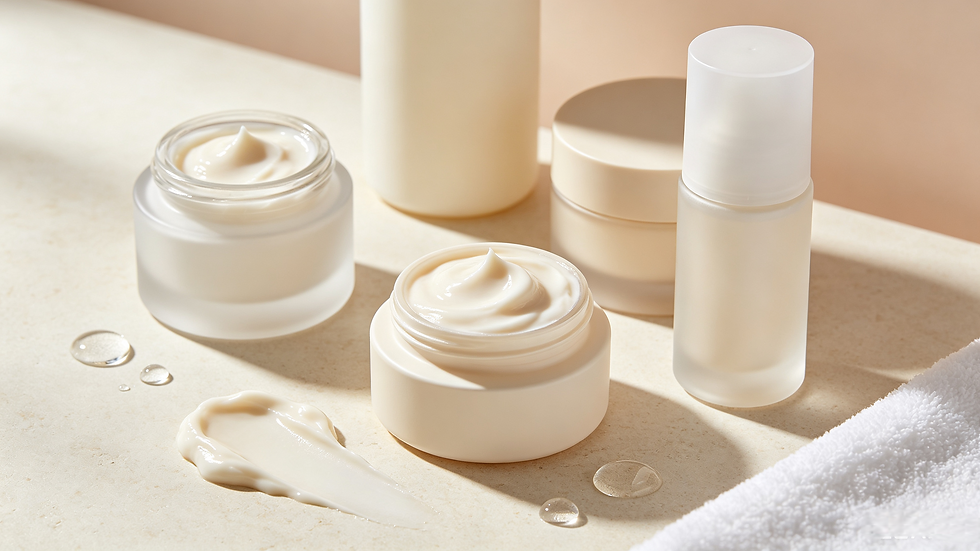
Breaking the "Water-Oil Incompatibility" Curse: The Thermodynamic Essence of Interfacial Tension
To master cream stability, one must first confront the inherent thermodynamic flaws of emulsion systems. In physical chemistry, mixing oil and water to form an emulsion is a process that drastically increases the contact area between the two phases. According to the Gibbs free energy principle, this increase in interfacial area causes the system's total free energy to spike, placing the emulsion in a highly unstable metastable state. To reduce surface energy, droplets spontaneously collide and coalesce, ultimately leading to water-oil separation.
Interfacial tension is precisely this "shrinking force" the system uses to minimize its surface area. Therefore, the core engineering of cream stability is to use emulsifiers (surfactants) to precisely lower the oil-water interfacial tension, thereby reducing the system's Gibbs free energy.
In real formulation design, we do not blindly pursue ultra-low interfacial tension; rather, we seek a "thermodynamic equilibrium point." By introducing non-ionic emulsifiers and co-emulsifiers with specific molecular structures, we construct a dense interface film with steric hindrance at the oil-water boundary. This film not only drastically lowers interfacial tension but also thoroughly locks down the pathway for droplet coalescence through the dual action of electrostatic repulsion and steric hindrance, granting the cream years of shelf-life stability at the physicochemical root.
Formulation Reconstruction: Precise HLB Matching and "Liquid Crystal Interface Film" Construction
Lowering interfacial tension is never about simply stacking single emulsifiers; it is a precise design of the Hydrophilic-Lipophilic Balance (HLB) and the micro-structure of the interface film. In our 2026 premium cream formulation matrix, we have comprehensively upgraded to "Biomimetic Liquid Crystal Emulsions."
While traditional emulsion systems only form a single molecular layer at the oil-water interface, our liquid crystal technology precisely compounds specific HLB emulsifiers (such as Cetearyl Glucoside) with co-emulsifiers (such as Phytosterols and Ceramide precursors) to construct a multi-layer "Lamellar Liquid Crystal" structure at the interface. This structure is highly similar to the intercellular lipids of the human stratum corneum.
This special interface film possesses extreme mechanical strength and flexibility, minimizing interfacial tension to maintain absolute system stability. More importantly, its lamellar structure can wrap massive amounts of water and lipophilic actives. When this low-interfacial-energy liquid crystal system contacts the skin, its physical structure is highly homologous to the skin's own lipid barrier, drastically reducing the skin's rejection of foreign substances and laying a perfect physiological foundation for subsequent active release.
From "Physical Stability" to "Bioavailability": Transdermal Penetration Driven by Low Interfacial Energy
Ultimate Spreadability: In real application scenarios, low-interfacial-energy creams instantly spread evenly across skin textures, forming an ultra-thin, uniform liquid film. This completely eliminates the "heavy" and "dragging" sensations caused by traditional high-tension creams.
Tricking the Barrier: More crucially, this low-interfacial-energy lipid system can "trick" the stratum corneum barrier. Because the formulation's interface structure is highly similar to the skin's lipid bilayer, active ingredients can smoothly penetrate through the Lipid pathways, bypassing the dense stratum corneum to reach the deep epidermis.
This transdermal penetration mechanism driven by low interfacial tension allows brand owners to achieve superior efficacy without blindly increasing active concentrations, thereby optimizing BOM (Bill of Materials) costs while ensuring product mildness.
Process Barriers & Mass Production Validation: Closed-Loop Control of Shear and Micro-Morphology
Translating a perfect low-interfacial-tension formula from the lab into a stable, 10-ton mass-produced cream is an ultimate test of an OEM factory's process control capabilities. The formation of the interface film and the reduction of interfacial tension are extremely dependent on shear force and temperature control during emulsification. Excessive homogenization shear will destroy the newly formed liquid crystal interface film; insufficient shear will fail to refine droplets to the ideal micron level, resulting in inadequate interfacial area and ineffective tension reduction.
Our factory has established a full-chain micro-morphology monitoring and process scale-up matrix:
Precision Emulsification: We utilize High-Pressure Microfluidization and multi-stage temperature-controlled homogenization to ensure that within the optimal thermodynamic window, oil droplets are uniformly refined to 1–5 microns, and co-emulsifiers are perfectly embedded into the interface film.
QC Validation: We use a Laser Particle Size Analyzer to strictly monitor the particle size distribution of every batch, ensuring no large-particle aggregation. Simultaneously, we use Polarized Light Microscopy to directly observe the micro-morphology of the emulsion, confirming the intact formation of the lamellar liquid crystal structure.
Only when the microscopic data perfectly aligns with macroscopic high/low-temperature cycling and centrifugation stability tests (per ISO standards) is the product approved for release.
Who takes a cream brief all the way to a repeatable, shelf-ready line?
Bringing a cream brief from concept to a shelf-ready, repeatable formula takes more than a formulator. We work from barrier science and validated delivery systems, not ingredient claims.
Every cream project runs through a defined stability, compatibility and sensory protocol before it reaches pilot batch — so what you approve in the sample is what the line produces.
By collaborating with Explore our formulation and R&D capability you gain access to industry-leading expertise and innovative formulations that set your brand apart in the competitive global market. Send your target profile, market and volume; we will return a feasibility assessment with indicative cost and timeline.


Comments