The Quantitative Model of Sunscreen Spray Deposition Efficiency: Impact Curves of Spray Distance, Angle, and Duration on Skin Adhesion

Updated: Sep 17
Before discussing the development and consumer education of sunscreen sprays, we must first define the physical and fluid dynamics essence of "Sunscreen Spray Deposition Efficiency."
Global sunscreen regulations mandate a standard application rate of 2.0 mg/cm² for SPF testing. However, because spray formats rely on aerosol or mechanical pump atomization, their actual protective power highly depends on consumer behavior. Sunscreen Spray Deposition Efficiency refers to the proportion of the formula ejected from the nozzle that ultimately adheres effectively to the skin surface to form a continuous sunscreen film.
The "collapse of protection" of sunscreen sprays in real-world scenarios mainly occurs through three pathways: first, droplet coalescence and run-off, causing local liquid accumulation and loss due to gravity; second, excessive evaporation and drift, causing the formula to dry up or scatter in the wind before reaching the skin; third, discontinuous film layers, where insufficient deposition per unit area leads to "pinhole defects" in the sunscreen film, allowing UV rays to penetrate directly. These three pathways dictate that developing sunscreen sprays cannot rely solely on "increasing the formula's SPF value," but must establish a "Sunscreen Spray Deposition Efficiency quantitative model" based on fluid dynamics and ergonomics.
Currently, the core variables for controlling Sunscreen Spray Deposition Efficiency in the industry are dominated by three dimensions: Spray Distance (aerosol diffusion control), Spray Angle (momentum transfer and geometry), and Duration & Discharge Rate (film continuity management).
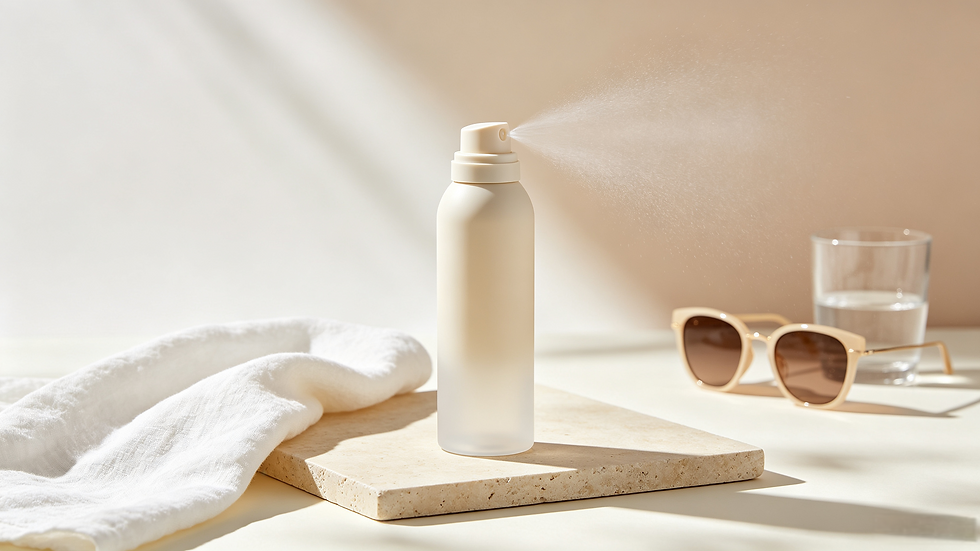
Category 1: Spray Distance - The "Golden Deposition Window" Against Droplet Coalescence and Flash Evaporation in Sunscreen Spray Deposition Efficiency
Physical and Fluid Dynamics Mechanisms
Spray distance directly determines the kinetic energy decay and solvent evaporation degree of droplets before they impact the skin. The operational logic is to find a balance point between "droplet coalescence" and "flash evaporation."
Too Close (<5 cm) - "Coalescence and Run-off": At this distance, droplet kinetic energy is extremely high, and they haven't fully dispersed. Upon impact, a large number of droplets coalesce into large drops. Because the sunscreen formula contains oils and film formers, these large drops cannot spread rapidly on the skin surface. Under gravity, they form "run-off," significantly reducing actual adhesion and causing extremely uneven distribution.
Too Far (>25 cm) - "Flash Evaporation and Drift": Sunscreen sprays usually contain a high proportion of volatile solvents (like ethanol or isododecane). When the distance is too far, the solvents in the droplets vaporize massively during flight. By the time they reach the skin, they have become semi-dried, dust-like particles. These particles cannot fuse into a film on the skin but instead drift away with the air (overspray) or attach to clothing, causing a cliff-like drop in effective deposition.
Real Quantitative Curves and Engineering Control
Deposition-Distance Curve: In classic laser particle size analysis and deposition weighing tests, the deposition per unit area and spray distance typically show an "inverted U-shaped" parabolic relationship. The peak (the golden deposition window) usually appears at a distance of 10 cm - 15 cm from the skin. At this point, droplet kinetic energy is moderate, ensuring even spreading without excessive coalescence or evaporation.
Engineering Control: Formulators must work closely with packaging engineers to adjust the nozzle's Spray Cone Angle and droplet median particle size (D50) based on the target distance. For example, for a 15cm usage distance, the D50 needs to be controlled between 50-80μm to ensure droplets can penetrate the still air layer on the skin surface and adhere effectively.
Limitations
Consumer usage habits are extremely difficult to standardize. In outdoor windy environments or when wearing clothes, consumers often unconsciously shorten or lengthen the spray distance, causing the Sunscreen Spray Deposition Efficiency to deviate from the golden window.
Category 2: Spray Angle - The "Momentum Transfer Geometry" Against Gravity Slip and Curved Surface Bounce in Sunscreen Spray Deposition Efficiency
Physical and Fluid Dynamics Mechanisms
The spray angle determines the momentum decomposition when droplets impact the skin. The operational logic is to maximize momentum transfer in the vertical direction and minimize slip and bounce in the tangential direction.
Vertical Spray (90°) - Maximum Adhesion: When the nozzle is perpendicular to the skin surface, the kinetic energy of the droplets is entirely used to overcome the microscopic roughness and air resistance of the skin surface, achieving maximum spreading and adhesion.
Tilted Spray (<45°) - Slip and Loss: When the angle is tilted, the droplet's kinetic energy is decomposed into vertical and tangential components. The tangential component causes droplets to "slip" on the skin surface. Especially on cylindrical curved areas like limbs (calves, arms), gravity superimposes on the tangential force, causing a large number of droplets to slide off directly. Additionally, the "edge effect" of droplets intensifies at tilted angles, leading to severe "striped" uneven distribution within the coverage area.
Real Quantitative Curves and Engineering Control
Deposition-Angle Curve: In flat surface tests (like the back), as the angle drops from 90° to 45°, deposition usually decreases by 20%-30%. However, on curved surfaces (like shoulders or calves), tilted spraying causes a cliff-like drop in deposition (>50%), and the film thickness variance (Rmax) significantly increases.
Engineering Control:
Fan-spray Nozzles: Abandoning traditional cone nozzles in favor of fan-spray nozzles. Fan sprays form a uniform "sheet-like" liquid curtain, greatly reducing the bounce of edge droplets and improving coverage uniformity on curved surfaces.
BOV (Bag-on-Valve) 360° Inverted Valves: Traditional dip-tube sprays eject gas before liquid when tilted or inverted, leading to extremely low initial deposition. BOV technology seals the formula in a flexible bag, ensuring that at any angle (including completely inverted), the propellant pushes the formula out at a constant pressure, guaranteeing Sunscreen Spray Deposition Efficiency during tilted use.
Limitations
Even with fan-spray nozzles and BOV valves, physical laws dictate that it remains difficult to achieve a uniform 2mg/cm² deposition on complex curved areas (like joints or collarbones). This must be compensated through consumer education ("rub in evenly after spraying").
Category 3: Duration and Discharge Rate - The "Critical Thickness Management" Against Film Pinhole Defects in Sunscreen Spray Deposition Efficiency
Physical and Fluid Dynamics Mechanisms
The discharge rate (g/s) of a sunscreen spray is fixed once the packaging is finalized. Therefore, the spray duration directly determines the deposition per unit area. The operational logic is to ensure the deposition crosses the "critical film thickness" to eliminate "pinhole defects" in the sunscreen film.
Film Continuity and SPF Decay: According to sunscreen film optical theory, when the deposition per unit area is below 1.0 mg/cm², the sunscreen film cannot form a continuous phase, and the surface will be covered with micron-level "pinholes." UV rays will penetrate these pinholes directly, causing the actual SPF value to decay exponentially (e.g., when deposition is only half the standard, the actual SPF might be less than 20% of the labeled value).
Linear Relationship Between Duration and Deposition: At a fixed distance and angle, deposition is strictly linearly positively correlated with spray duration. However, the relationship between "effective protection" and duration is non-linear—before reaching the critical film thickness, protection is extremely low; once the critical point is crossed, protection rises exponentially to a plateau.
Real Quantitative Curves and Engineering Control
Deposition-Duration Curve: Assuming a sunscreen spray has a discharge rate of 0.8 g/s, and the target spray area is 100 cm² (e.g., one forearm). To achieve the standard deposition of 2.0 mg/cm² (requiring a total of 0.2 g), this area needs to be sprayed continuously for at least 2.5 seconds.
Engineering Control:
Discharge Rate Calibration: The factory must conduct strict discharge rate weighing tests for every batch of spray pumps/aerosol cans, ensuring batch-to-batch variation is < 5%.
Packaging Labeling and Visualization: Clearly label the "recommended spray seconds per area" (e.g., "Spray for 3 seconds") in a prominent position on the packaging. A more advanced engineering solution is to introduce Indicating Technology—the spray appears slightly white when wet (helping consumers confirm sprayed areas and uniformity) and turns transparent after drying into a film, providing intuitive "deposition visualization" feedback to prevent missed spots.
Limitations
Consumers lack extreme patience; very few are willing to continuously spray a single area for more than 3 seconds. This leads to the actual usage deposition of most sunscreen sprays on the market being far below 2mg/cm². This is also the fundamental reason why dermatologists always recommend "rubbing in evenly after spraying spray products and reapplying a second time."
Can your manufacturing partner hold this tolerance in production?
A specification that passes on the bench and drifts at scale is a process-control problem, not a formula problem. We treat this as an engineering parameter with a measured control window, not a QA checkbox.
Our lines pair in-process measurement with batch-level documentation, so what is approved in the sample is what ships in the order — reorder after reorder.
By collaborating with Explore our skincare manufacturing capabilities you gain access to industry-leading expertise and innovative formulations that set your brand apart in the competitive global market. Send us your current spec and observed deviation — we will tell you whether it is a formulation fix or a process fix.
Core Takeaways of Sunscreen Spray Deposition Efficiency
"Effective protection of sunscreen sprays" never relies solely on the SPF value in the formula.
Spray Distance is responsible for "controlling droplet diffusion" (finding the 10-15cm golden window / preventing coalescence and flash evaporation).
Spray Angle is responsible for "optimizing momentum transfer" (vertical spraying / preventing curved surface slip).
Duration and Discharge Rate are responsible for "ensuring film continuity" (crossing critical film thickness / eliminating pinhole defects).
Only by perfectly quantifying and synergizing fluid dynamics, packaging engineering, and consumer behavioral science can we unlock the ultimate answer for modern sunscreen sprays to avoid failures and provide real protection, maximizing Sunscreen Spray Deposition Efficiency.


Comments