The Real Boundaries of Botanical Preservation Toner Formulation: Antimicrobial Spectrum and Formulation Compatibility of Tea Tree Oil and Rosemary Extract

Updated: Sep 17
In 2026, as "Clean Beauty" and "natural skincare" trends dominate the global market, "botanical preservation" has become a highly attractive marketing concept for brand owners. Many brands hope to completely replace traditional chemical preservatives with natural ingredients like tea tree essential oil and rosemary extract to cater to sensitive-skin and eco-conscious consumers.
However, as a professional cosmetics OEM/ODM factory, we must reveal a rigorous scientific fact to brand owners: "Botanical Preservation Toner Formulation" has clear, definitive boundaries. Single plant extracts rarely can independently pass the stringent tests of modern cosmetic regulations as a broad-spectrum preservative. The true engineering breakthrough lies not in blindly pursuing the gimmick of "100% plant preservation," but in deeply understanding their antimicrobial spectrum and scientifically compounding them as "Preservative Boosters."
Today, starting from microbiology and formulation chemistry, we will deeply dissect the real antimicrobial boundaries and formulation compatibility engineering of tea tree oil and rosemary extract in Botanical Preservation Toner Formulation.
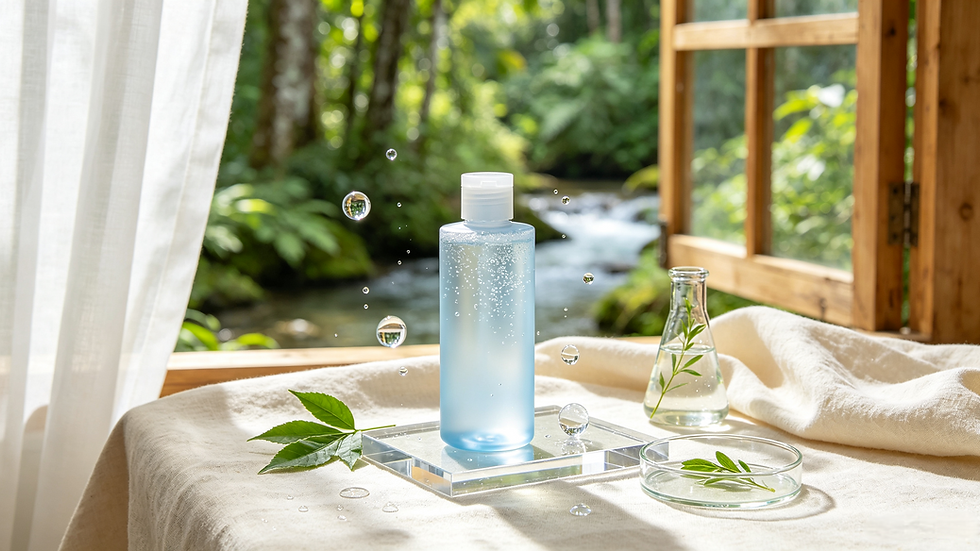
Scientific Root Causes: The Real "Antimicrobial Spectrum" in Botanical Preservation Toner Formulation
To evaluate the efficacy of botanical preservation, we must clarify their active ingredients and the specific microorganisms they target.
1. Tea Tree Oil: Targeted Inhibition and Natural Limitations
According to the international standard ISO 4730, the core active ingredient of high-quality tea tree oil is Terpinen-4-ol, with its content typically required to be >30% (premium grades can exceed 40%).
Antimicrobial Advantage: Terpinen-4-ol can effectively disrupt the cell membrane permeability of microorganisms. It exhibits significant inhibitory effects against Gram-positive bacteria (such as Staphylococcus aureus) and certain fungi (such as Candida albicans and Cutibacterium acnes).
The Real Boundary: Tea tree oil has relatively weak inhibitory effects against certain Gram-negative bacteria, especially Pseudomonas aeruginosa. P. aeruginosa is precisely one of the "hardest-to-eradicate" standard strains in cosmetic Preservative Efficacy Testing (PET). Therefore, single tea tree oil cannot provide broad-spectrum preservation protection in Botanical Preservation Toner Formulation.
2. Rosemary Extract: Antioxidation Over Direct Bactericidal Action
The core active ingredients of rosemary extract are Carnosic acid and Rosmarinic acid.
Real Positioning: Its primary role in a formula is as a potent natural antioxidant, not a direct bactericide. By preventing the oxidative rancidity of oils in the formula, it indirectly eliminates the breeding ground for microorganisms. In the preservation system, its more accurate positioning is a "Preservative Booster," enhancing the overall stability of the system through synergistic effects rather than fighting alone.
Formulation Engineering Breakthroughs: Overcoming the "Compatibility Barriers" of Water Solubility and Stability
In OEM/ODM development, integrating essential oils and plant extracts into high-moisture toner systems faces immense physicochemical challenges. We achieve compatibility through the following strategies for Botanical Preservation Toner Formulation:
Strategy 1: Green Solubilization Technology
Tea tree oil is a highly hydrophobic, lipophilic substance with extremely low solubility in water. Traditional formulas often use PEG-40 Hydrogenated Castor Oil for solubilization, which contradicts the "Clean Beauty" philosophy.
Engineering Solution: We employ natural-origin polyglycerol esters (such as Polyglyceryl-10 Laurate) combined with Pentylene Glycol to build a green micro-emulsion solubilization system. This not only evenly disperses the essential oil into nano-sized transparent droplets, but the pentylene glycol itself also provides synergistic antimicrobial effects, killing two birds with one stone.
Strategy 2: Antioxidant Matrix Escort to Prevent "Sensitization Reversal"
Terpene compounds in tea tree oil are highly susceptible to oxidation by air. Oxidation products (such as peroxides) are strong skin sensitizers.
Engineering Solution: In formulas containing tea tree oil, we mandatorily compound a natural antioxidant matrix (e.g., Rosemary Extract + Tocopherol). This not only extends the shelf life of the essential oil but also blocks the generation of sensitizing oxides at the source, ensuring the gentleness of the Botanical Preservation Toner Formulation.
Strategy 3: Building a "Plant Extract + Gentle Polyol" Synergistic Preservation Network
Based on the limitations of the antimicrobial spectrum of botanical preservation, we absolutely do not recommend brand owners rely solely on plant extracts.
Engineering Solution: We adopt a ternary synergistic matrix: "Tea Tree Oil/Rosemary Extract (providing targeted inhibition and antioxidation) + 1,2-Hexanediol/Caprylyl Glycol (providing broad-spectrum cell membrane disruption) + Hydroxyacetophenone (providing fungal inhibition and antioxidation)." This design meets the claim requirement of "free from traditional controversial preservatives (like parabens, isothiazolinones)" while ensuring an absolute safety baseline.
Manufacturing & QC Challenges: The Engineering Barriers of Botanical Systems
The natural attributes of plant raw materials bring severe tests to the QC system of contract manufacturers.
Challenge 1: Batch Fluctuation of Active Ingredient Content
Affected by origin, climate, and extraction processes, the content of Terpinen-4-ol in different batches of tea tree oil may fluctuate, directly impacting antimicrobial efficacy.
QC Countermeasure: During incoming material inspection, we mandatorily introduce Gas Chromatography-Mass Spectrometry (GC-MS) for fingerprint analysis. We strictly stipulate that the Terpinen-4-ol content must meet the standard (e.g., ≥38%); otherwise, it is rejected, ensuring consistent preservation efficacy in every batch of Botanical Preservation Toner Formulation.
Challenge 2: Odor Management and Sensory Purity
Tea tree oil has a strong medicinal herbal scent; adding it directly without treatment will severely affect the sensory experience of high-end toners.
QC Countermeasure: We use a precise natural botanical fragrance matrix (e.g., compounding trace amounts of lavender and chamomile essential oils) for odor harmonization, or employ molecular distillation technology in the early stages to remove some irritating volatiles. This achieves sensory purity and pleasure while retaining antimicrobial activity.
Validation Pathway: The Rigorous Closed Loop from In-Vitro Inhibition to Regulatory Challenge Testing
In the B2B supply chain, claims of "botanical preservation" must be built upon indisputable instrumental and regulatory testing. Our factory has established an exclusive validation closed loop:
Minimum Inhibitory Concentration (MIC) Determination
In the lab, we determine the MIC value of the plant extract compounding system against target strains (e.g., S. aureus, C. albicans), using data to prove its true antimicrobial efficacy at specific concentrations.
ISO 11930 Preservative Efficacy Testing (PET)
This is the "gold standard" for testing whether a preservation system is qualified. We inoculate samples with five standard strains (including the resilient P. aeruginosa and Aspergillus brasiliensis) and perform colony counting on days 2, 7, 14, and 28.
Actual Test Conclusion: Our data repeatedly proves that a single plant extract cannot pass the Criteria A standard; whereas the formula adopting the "plant extract + polyol synergistic matrix" consistently meets the stringent standard of bacteria dropping ≥2 log in 2 days with no rebound at 28 days.
Human Repeat Insult Patch Test (HRIPT)
For formulas containing essential oils, we conduct HRIPT to ensure that oxidation control and solubilization technologies have effectively reduced sensitization risks, achieving the safety level of "suitable for sensitive skin" in Botanical Preservation Toner Formulation.
Conclusion: Reshaping the True Value of "Botanical Preservation" with Scientific Rationality
"Botanical preservation" should not be a marketing gimmick, but rigorous formulation science. Acknowledging the antimicrobial boundaries of tea tree oil and rosemary extract, and compensating for these boundaries through green solubilization, antioxidant escort, and polyol synergistic compounding, is the true professional embodiment of modern cosmetic OEM/ODM. Mastering this "botanical synergistic preservation" engineering is the winning key for brand owners to tell a great natural story while holding the safety baseline in the clean beauty track.
Partner with Deva Skincare for Next-Generation Botanical Preservation Toner Formulation
Are you looking for a reliable skincare factory that can engineer scientifically robust, clean-beauty toners with effective botanical preservation?
Are you seeking a trusted partner to launch or scale your skin care line with precise plant-based antimicrobial matrices and rigorous ISO challenge testing? At Deva Skincare, we specialize in developing safe formulations that combine barrier science with clean, compliant manufacturing, specifically engineered for the next generation of natural skincare.
Our R&D and microbiology teams deliver turnkey OEM/ODM solutions featuring advanced Botanical Preservation Toner Formulation, precise GC-MS fingerprinting of essential oils, green solubilization technologies, and rigorous ISO 11930 Preservative Efficacy Testing (PET). We ensure your "plant-boosted" toners deliver scientifically proven, broad-spectrum microbial safety without relying on controversial traditional preservatives, perfectly tailored to your target market’s standards.
See the categories we already manufacture at scale: Explore our formulation and R&D capability. Contact us today to discover how our advanced Botanical Preservation Toner Formulation capabilities can help you succeed.


Comments