The "Waterproof Mascara" Makeup Removal Challenge: Dissolution Strategies for Silicones, Film Formers, and Waxes

Updated: Sep 17
I. Waterproof Mascara: One of the Most Challenging Makeup Categories to Remove Globally
Waterproof mascara is the most technologically advanced and hardest-to-remove category in the eye makeup market for ordinary makeup removers.
The global mascara market was valued at approximately $7.11 billion in 2026, with 55% of consumers explicitly preferring waterproof formulas. In terms of market size, the global waterproof makeup market reached $17.8 billion in 2025 and is projected to grow to $37.5 billion by 2035, at a CAGR of 7.7%. This means that every day, hundreds of millions of people worldwide face the same morning challenge—how to completely remove the mascara that has survived an entire day, a swim, and remains perfectly intact on their lashes.
However, most makeup removers on the market are powerless against waterproof mascara: after repeated rubbing, the panda-eye circles below the lash line remain faintly visible, or it even smudges worse. The problem is not the technique, but that formulation engineers must first understand the "enemy."
II. The "Defense Fortifications" of Waterproof Mascara: Triple Water-Resistant Mechanism
To design makeup removal products that can effectively dissolve waterproof mascara, one must first deconstruct the structure of waterproof mascara from a formulation perspective. The core secret of waterproof mascara lies in its water-in-oil (W/O) emulsion or anhydrous formula base: high concentrations of volatile solvents (such as isododecane) evaporate rapidly after application, leaving behind a hydrophobic barrier composed of waxes and film-forming polymers on the lash surface, actively repelling water and moisture.
Layer 1: Wax Matrix
In waterproof mascara formulations, natural waxes typically account for 20–30%, mainly including Carnauba Wax, Candelilla Wax, and Beeswax, providing heat-resistant structure and water-resistant adhesion. Silicones are usually added at 5–10% Dimethicone to repel moisture while maintaining a smooth texture. Plasticizers (such as castor oil derivatives) are added at 2–5% to counteract the brittleness caused by high concentrations of waterproof ingredients, preventing the mascara from cracking or flaking after drying.
Dissolution Characteristics of the Wax Layer: The melting point of waxes is typically between 60–85°C (Carnauba Wax ~83°C, Beeswax ~62°C). At room temperature, they exist as solid crystal structures. Simple water-based makeup removers cannot penetrate or dissolve this wax network; oil-phase ingredients with sufficient dissolving power must be relied upon.
Layer 2: Silicone Barrier
Dimethicone and cyclic silicones (such as Cyclopentasiloxane and Cyclohexasiloxane) are the "waterproof main forces" of waterproof mascara. Dimethicone prevents moisture absorption by forming a uniform hydrophobic layer on each lash—this is the key to resisting smudging and flaking. Unlike certain ingredients that cause lash dryness, dimethicone maintains lash flexibility and softness while providing waterproofing.
Dissolving silicones requires dedicated silicone-soluble solvents or specific polar oils—this is precisely why ordinary mineral oils or plant oils have limited effectiveness in removing waterproof mascara.
Layer 3: Film Former Network
This is the most challenging layer to conquer. Oil-soluble silicone film formers, especially Trimethylsiloxysilicate (MQ Resin), are currently the first choice for waterproof and long-wear makeup formulations due to their combination of transfer-resistance, water-resistance, and flexibility, locking pigments tightly onto the lash surface without cracking from bending movements. Other common waterproof film formers include VP/Eicosene Copolymer and Acrylates Copolymers.
Compatible solvents required for dissolving silicone resins include: Isopropyl Palmitate, Triglycerides, Cyclomethicone, C12-15 Alkyl Benzoate, Isododecane, and Isohexadecane. Among these, silicone resin dissolves fastest in Isododecane (in less than 20 minutes), and takes about 20–30 minutes in Cyclomethicone.
III. Dissolution Strategies to Break the Triple Barrier
Strategy 1: Oil Phase First — "Oil Dissolves Oil/Wax/Silicone"
"Like dissolves like" is the core principle of waterproof mascara makeup remover formulation design. Oil-soluble ingredients are the only effective means of dissolving waxes, silicones, and film formers. The dissolving power of different oils for the three types of ingredients varies significantly:
INCI Name | Wax Dissolving Power | Silicone Dissolving Power | Film Former Dissolving Power | Comprehensive Evaluation |
Isododecane | Medium | Strong | Strong (MQ Resin) | Fast evaporation; first choice for dissolving MQ resin; but pure oil feel unsuitable for water-based removers |
Cyclopentasiloxane | Medium | Extremely Strong | Strong | Lightweight, excellent volatility; core oil phase for biphasic eye makeup removers |
Ethylhexyl Palmitate | Strong | Weak | Weak | Excellent wax dissolving power; relatively greasy skin feel |
Caprylic/Capric Triglyceride | Strong | Weak | Weak | Natural origin; first choice for Clean Beauty, suitable for organic certified formulas |
Hydrogenated Polyisobutene | Strong | Weak | Medium | Common in Asian waterproof removers; lightweight texture, comfortable skin feel |
Formulation Strategy: Use Cyclopentasiloxane (15–30%) as the base to dissolve silicones and film formers, paired with Caprylic/Capric Triglyceride (5–15%) to dissolve the wax matrix, forming a dual-effect oil phase system that addresses the dissolution needs of all three barriers.
Strategy 2: Bi-Phase Remover — The Product Format Designed Specifically for Waterproof Makeup
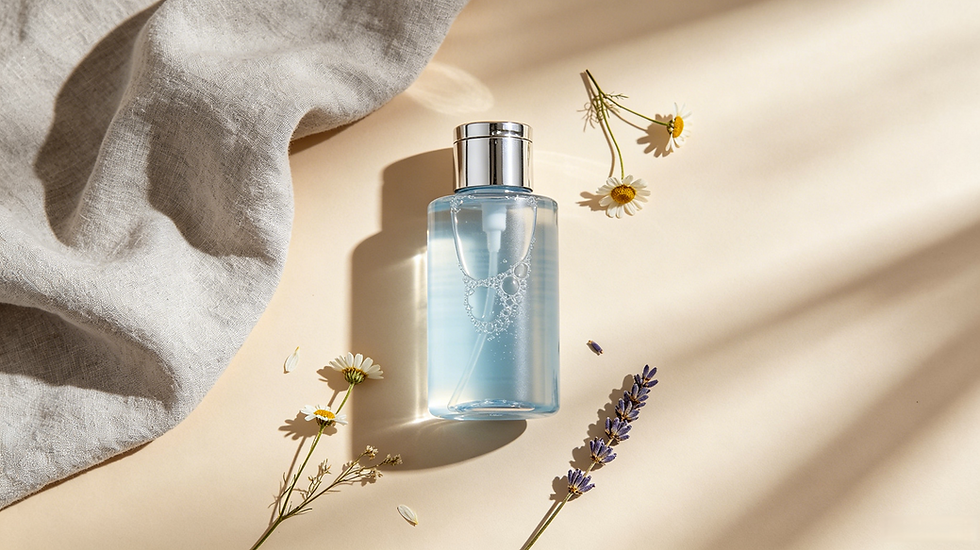
Bi-phase makeup removers are currently the most mainstream product solution in the international market for waterproof mascara. Its structural principle is: the upper oil phase (silicone oil + lightweight oils, approx. 40–50%) is responsible for dissolving waxes, film formers, and silicones; the lower water phase (water + gentle surfactants + humectants) is responsible for removing oily residue after makeup removal while providing a refreshing finish.
When shaken before use, the two phases mix to form a transient emulsion, combining cleansing power with easy rinseability; after resting, they naturally separate, and the appearance becomes the visual differentiator of the product.
💡 Real Ingredient Reference: The oil phase main body of Neutrogena's biphasic eye makeup remover consists of Cyclopentasiloxane and Cyclohexasiloxane, and it has passed ophthalmological tolerance testing, making it suitable for contact lens wearers.
Strategy 3: Soaking Dwell Time — The "Contact Kinetics" That Cannot Be Ignored
Even if the correct oil-phase ingredients are selected, the dissolution process still requires time. The polymer network formed by waterproof film formers is a cross-linked structure, and its dissolution rate is affected by the following factors:
Contact Time: It is recommended to press the cotton pad against the lashes and let it sit for 10–15 seconds, allowing the oil phase to fully penetrate the wax layer before gently sliding downward to wipe—rather than immediately rubbing back and forth.
Temperature: Formulation principles indicate that heating is required when dissolving heavy waxes with petroleum fractions during manufacturing. In actual use, appropriate body temperature (35–37°C) is already sufficient to accelerate wax swelling, which is also the physical reason why pressing the cotton pad yields better results.
Mechanical Force: Avoid repeated rubbing—waterproof formulations are not inherently harmful to lashes themselves; most damage occurs during improper makeup removal: forceful rubbing to break the hydrophobic polymer causes lash breakage. Using oil-based makeup removal products is key to maintaining lash health.
IV. Three Advanced Dimensions of Formulation Design
Dimension 1: PFAS Alternatives — A Necessary Consideration for Regulatory Compliance
According to InStyle reports, approximately 82% of waterproof mascaras have been found to contain fluorinated compounds (PFAS), which are used to enhance water resistance and have attracted high regulatory attention, driving the industry toward PFAS-free formulation innovation. This also impacts makeup remover formulations—as waterproof mascaras gradually move away from PFAS systems toward composite film-forming systems of silicone resins + acrylate polymers, the dissolution strategies of makeup removers must also be adjusted accordingly.
Dimension 2: Oil Phase Alternatives Under Clean Beauty Positioning
For markets targeting organic certification (COSMOS) or Clean Label positioning, cyclic silicones such as cyclopentasiloxane cannot be used (the EU has restricted cyclic tetra- and pentasiloxanes). Alternative solutions:
Jojoba Esters: Liquid crystal structure, strong penetration, can serve as a wax dissolving agent.
Caprylic/Capric Triglyceride (Natural Origin): Replaces synthetic lightweight oils; suitable for Clean Beauty certified products.
Squalane: Plant-derived, lightweight texture, good dissolving power for wax matrices.
Dimension 3: The Bottom Line of Periorbital Safety
Biphasic makeup removers and other oil-based makeup removal products have potential irritation to the eyes, which may cause stinging or leave an oily film residue around the eyes, causing discomfort. Therefore, professional-grade eye-area waterproof makeup removers must simultaneously meet the following requirements in formulation design: pH 6.5–7.5 (close to tear fluid pH); oil-phase ingredients must pass ophthalmological irritation testing (Draize Test or ophthalmological tolerance testing); free of known eye allergens (fragrance, MIT, etc.).
V. Market Opportunity: Waterproof Makeup Removal is the Ticket to Professional Differentiation
The global mascara market was valued at approximately $6.49 billion in 2026, with growth drivers including 52% of consumers demanding multi-functional formulas, 41% preferring Clean Label products, and 44% focusing on smudge-proof products. When brand owners launch waterproof mascara product lines, they often need a "matching" high-efficiency makeup removal product to complete the closed-loop user experience—this is precisely the value entry point for OEM/ODM factories: providing professional makeup removal formulations that precisely match the ingredient systems of waterproof makeup, rather than "universal" makeup removers.
The claim on the label has to survive the stability test.
Brands specify an active for the story, then discover the story does not hold at month 24. We select the delivery system and the preservative compatibility together, so the claim is still true when the product is on shelf.
That is the gap between a marketing concept and a sellable formula — and it is closed in R&D, not in QC.
By collaborating with Explore our formulation and R&D capability you gain access to industry-leading expertise and innovative formulations that set your brand apart in the competitive global market. Tell us the claim and the target market; we will tell you what is achievable and what it costs.


Comments