Vibration Testing Standards for Sunscreen Spray Transit Safety: Valve Seal Verification Under Simulated Logistics Environments

Updated: Sep 17
In the highly developed cross-border e-commerce and long-distance cold chain logistics of the global beauty market in 2026, sunscreen sprays (especially aerosol formats) have become a blockbuster category for brand owners expanding overseas, thanks to their excellent reapplication experience. However, for numerous brand owners seeking OEM/ODM manufacturing, a highly destructive supply chain pain point always follows: "transit micro-leakage" and "can bursting."
When products endure continuous low-frequency vibrations during cross-sea shipping, or high-frequency bumping during air and land transport, consumers often receive sticky bottles, completely empty containers, or even "hazardous goods" with valves blown off due to uncontrolled internal pressure. This not only triggers disastrous customer complaints and returns but may also lead to the brand facing rejection by logistics providers and penalties from regulatory authorities. As a professional cosmetics R&D and manufacturing factory, we know deeply that Sunscreen Spray Transit Safety is never as simple as "tightening the cap," but an extreme engineering project involving fluid dynamics, material fatigue, and thermodynamic balance. Today, we will deeply dissect the vibration testing standards and valve seal verification logic under simulated logistics environments, helping your brand build an impregnable supply chain safety defense line.
Scientific Root Causes: Why Long-Distance Vibration Breaches the Seal in Sunscreen Spray Transit Safety
To solve the problem of transit leakage, we must first clarify the real physical destruction mechanisms of sunscreen sprays in complex logistics environments.
Mechanical Resonance and "Fatigue Displacement" of Valve Components
The valve system of a sunscreen spray is a precision mechanical component. Under the continuous low-frequency vibration of long-distance truck transport or ship engines, if the stiffness of the valve spring resonates mechanically with the vibration frequency of the transport environment, it will cause the valve stem to undergo high-frequency micro-movements within the housing. This long-term micro-movement friction will wear the gasket or cause the spring to fatigue and relax, ultimately causing the static sealing critical point of the valve to fail and triggering chronic micro-leakage, severely compromising Sunscreen Spray Transit Safety.
"Water Hammer Effect" of Gas-Liquid Two-Phase Flow
The interior of an aerosol sunscreen spray is a high-pressure gas-liquid two-phase system where the formula and propellant (such as LPG, DME, or compressed gas) coexist. During severe bumping, the liquid formula and gaseous propellant will undergo violent rolling and impacts. When the high-speed moving liquid instantly impacts the bottom of the valve or the top of the can, it generates localized instantaneous high pressure (i.e., the water hammer effect). If this instantaneous pressure peak exceeds the yield strength of the valve seal, the formula will be forcibly "squeezed" out of the sealing gap.
"Vibration-Induced Shear Thinning" of Formulation Rheology
Many high-SPF sunscreen sprays add thickeners to increase the resting viscosity and prevent physical UV filters (like Titanium Dioxide) from settling. However, some traditional thickeners undergo irreversible "shear thinning" or structural collapse after prolonged mechanical vibration, causing the viscosity of the formula to drop cliff-like into a water-like low-viscosity liquid. This greatly increases the probability of capillary leakage through the microscopic gaps of the valve, undermining Sunscreen Spray Transit Safety.
Formulation and Packaging Breakthroughs: Building an "Anti-Vibration Thixotropic" and "Dynamic Sealing" Matrix
Addressing the triple destruction of long-distance transport, our factory has fully introduced "Transit Environment Adaptation Design" in 2026 formulation and packaging engineering, reshaping the product's pressure and vibration resistance from the inside out.
Upgrading Valve Systems for "Anti-Fatigue and Dynamic Sealing"
We abandon cheap generic valves and collaborate with top packaging suppliers to customize "anti-vibration grade" valve components.
High-Rebound Sealing Materials: We select special nitrile rubber (NBR) or fluoroelastomer (FKM) with an extremely low compression set as the valve seat gasket, ensuring excellent elastic recovery even under long-term vibration and high pressure.
Damping Spring Design: We optimize the wire diameter and number of coils of the valve spring to change its natural frequency, avoiding the resonance bands of mainstream transport vehicles; simultaneously, we introduce micro-damping design to absorb vibration energy and prevent high-frequency micro-movements of the valve stem, ensuring top-tier Sunscreen Spray Transit Safety.
"Anti-Vibration Thixotropic" Network in Formulation Rheology
To prevent the formula from thinning and leaking during vibration, we introduce rheology modifiers with strong "thixotropy" (such as specific modified bentonites or polymeric associative thickeners) into the formula. This thixotropic network endows the formula with "smart" rheological properties: at rest, it presents a high-viscosity gel state, firmly "locking" the sunscreen powders and resisting gravity and capillary leakage; when the consumer presses the nozzle (high shear force), the network instantly disintegrates, and the formula becomes a low-viscosity fluid for smooth spraying; after experiencing transport vibration (medium-low shear force), its thixotropic network can rapidly self-repair, maintaining sufficient structural strength and completely cutting off the leakage path of "thinning under vibration."
"Thermodynamic Buffering" Design for Propellants and Internal Pressure
Sufficient "headspace (ullage)" must be reserved inside the aerosol can as a buffer airbag. Through precise thermodynamic calculations, we optimize the filling ratio of the formula and propellant (usually reserving 15%-20% headspace). When internal pressure fluctuates due to temperature rise or severe vibration during transport, this compressible gas can act like a "shock absorber" to absorb pressure peaks, preventing instantaneous high pressure from breaching the valve seal.
Validation Pathway: The Rigorous Closed Loop for Simulating Real Logistics Environments
In the highly rational international B2B supply chain, claims of Sunscreen Spray Transit Safety must be built on rigorous physical testing that meets international standards. Our factory has established an exclusive "simulated logistics and seal verification closed loop."
1. Random Vibration Testing (ASTM D4728 / ISTA 3A)
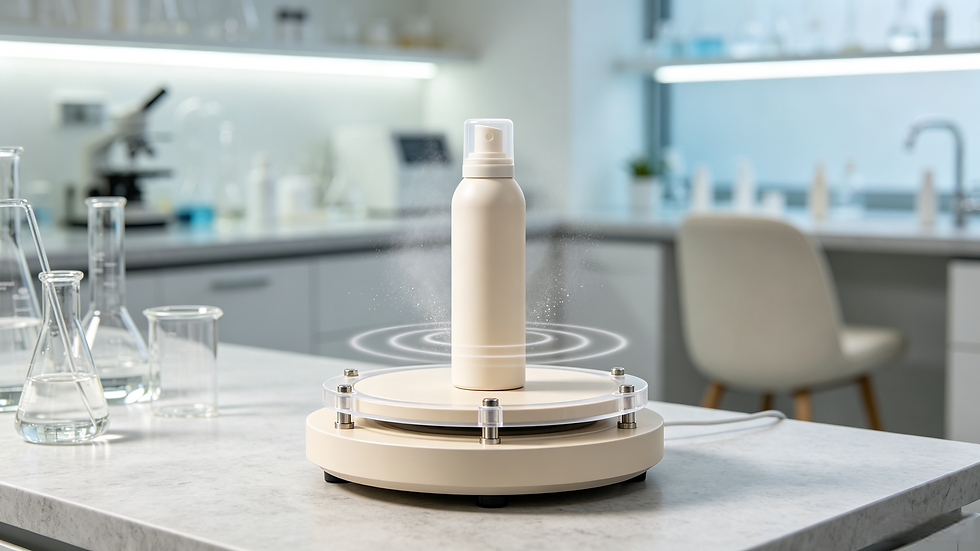
We abandon simple "shake tests" and introduce high-precision electromagnetic vibration tables. Strictly following ASTM D4728 (Random Vibration Test Standard) or ISTA 3A (General Simulation Performance Test for Packaged Products), we input the real collected Power Spectral Density (PSD) data of trucks, airplanes, and ships. Whole pallets or single bottles of sunscreen sprays undergo hours of random vibration on the shaker, simulating the real bumping spectrum in cross-border logistics, comprehensively evaluating the anti-fatigue properties of the valve components and the anti-vibration stability of the formulation's rheological network.
2. Vacuum Decay Leak Testing Post-Vibration
After the vibration test, how do we accurately capture the "micro-leakage" invisible to the naked eye? We place the samples into a high-precision vacuum decay leak tester. By extracting air from the test chamber to form negative pressure and using high-sensitivity sensors to monitor minute pressure changes. If the valve seal is damaged during vibration, the high-pressure propellant or formula inside the can will escape, causing the test chamber pressure to rise. This non-destructive quantitative testing can accurately intercept any batch with micro-leakage risks, guaranteeing Sunscreen Spray Transit Safety.
3. Coupled Stress Testing of Extreme Temperature and Vibration
Real cross-border logistics is often a double torment of "high temperature + vibration" (e.g., temperatures inside summer shipping containers can exceed 50℃, accompanied by ship bumping). We install a vibration module inside a high-low temperature alternating damp heat test chamber, superimposing high-intensity vibration at 50℃ (when the saturated vapor pressure inside the can is highest). This extreme coupled test can expose "thermodynamic-mechanical" synergistic failure risks that single tests cannot detect, ensuring the product remains completely leak-proof in the harshest logistics environments.
Compliance Claims and OEM/ODM Empowerment: Accurately Conveying "Supply Chain Security"
Under the global regulatory and logistics framework in 2026, brand owners must base their claims on real test data when promoting the transport safety of their products, avoiding absolute terms like "absolutely leak-proof."
Based on our simulated logistics validation data, the contract manufacturer can assist brand owners in formulating precise and competitive claim and logistics strategies for Sunscreen Spray Transit Safety:
Compliant Claims: Based on ASTM/ISTA test reports, legally use "Rigorous transport simulation tested," or "Leak-resistant valve technology under transit conditions."
Logistics Empowerment: The OEM can provide brand owners and third-party logistics providers (3PL) with complete "Certificates for Transport of Goods" and MSDS. Based on vibration test results, we provide professional guidance on palletizing and dunnage (buffer packaging) to reduce logistics damage rates and improve overall supply chain delivery yield.
Conclusion: Defending the Bottom Line of Cross-Border Delivery with Sunscreen Spray Transit Safety Engineering
The vibration testing and seal verification for Sunscreen Spray Transit Safety is a comprehensive test of a contract manufacturer's aerosol engineering heritage, rheological control, and packaging testing capabilities. In the fiercely competitive global overseas market, replacing blind filling with scientific thixotropic networks and dynamic sealing designs, and supporting logistics safety with rigorous ASTM/ISTA vibration data, is the only way for brands to avoid return disasters and win the trust of channels and consumers.
Partner with Deva Skincare for Bulletproof Sunscreen Spray Transit Safety & Aerosol Engineering
Are you looking for a reliable skincare factory that guarantees the transit safety and leak-proof integrity of your sunscreen sprays and aerosols?
Are you seeking a trusted partner to launch or scale your sun care line with formulations and packaging engineered to withstand the harsh realities of global cross-border logistics? At Deva Skincare, we specialize in developing advanced aerosol and pump-spray formulations backed by rigorous transport simulation testing and dynamic sealing technologies to ensure ultimate Sunscreen Spray Transit Safety.
Our R&D and packaging engineering teams deliver turnkey OEM/ODM solutions equipped with anti-fatigue valve systems, thixotropic rheological networks, and precise thermodynamic headspace calculations. We validate every batch through strict ASTM D4728 / ISTA 3A random vibration testing, coupled with vacuum decay leak detection and extreme temperature-stress challenges. We ensure your products arrive at their global destination perfectly intact, compliant, and ready for the market.
By collaborating with Deva Skincare, you gain access to industry-leading aerosol engineering, proactive supply chain risk management, and innovative formulations that protect your margins and set your brand apart in the competitive global market. Contact us today to discover how our transit-proven solutions for Sunscreen Spray Transit Safety can help you succeed.


Comments