Why Tear-Free Is Harder in a 2-in-1 Shampoo and Body Wash

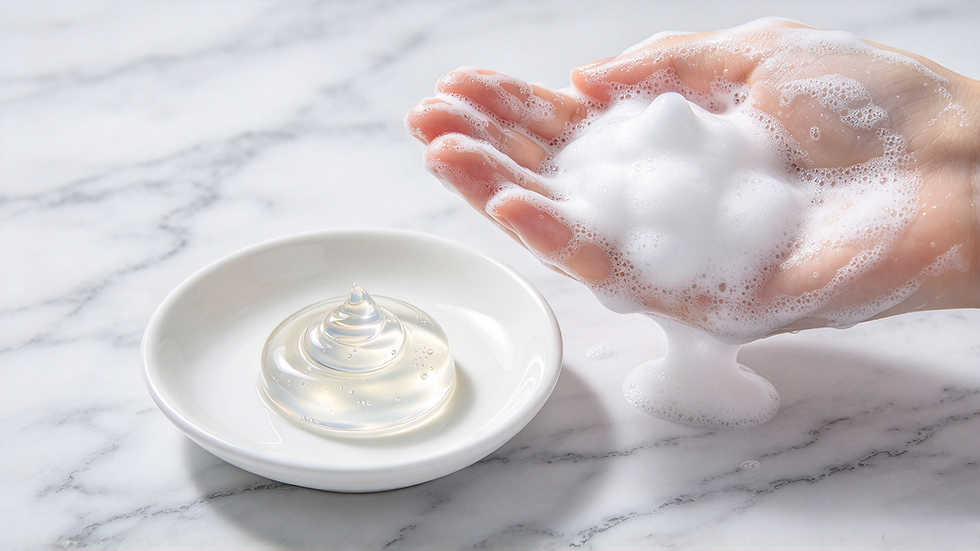
Tear-free is not a marketing adjective in a newborn care range. It is a formulation outcome. A tear-free 2-in-1 shampoo and body wash reaches that outcome through a narrower window than a single-use wash. A single-use wash optimises for one surface. A 2-in-1 cleans hair, cleans skin, and stays tolerable when lather reaches the eye. The eye then sets the limit for all three.
This article covers where the extra difficulty comes from. It walks through the three surfaces one formula serves and the trade-offs that follow. It also covers the test sequence we run at DEVA Skincare before a tear-free 2-in-1 shampoo goes near a baby.
What does tear-free actually mean in a 2-in-1 shampoo and body wash?
Tear-free describes one behaviour: lather reaching the eye does not sting. No regulator in the EU or the US defines the word. A brand substantiates it with test data instead. Regulation (EC) No 1223/2009 places that burden in the Cosmetic Product Safety Report. The US MoCRA regime does the same through facility registration and product listing.
Two variables decide whether a tear-free 2-in-1 shampoo earns the word. The first is how much surfactant reaches the conjunctiva once bath water dilutes the product. The second is the pH of the film that carries it. The tear film sits near pH 7.4. A product at pH 5.0 reads to the cornea as an acid load. Published tear-free bases usually sit between pH 6.5 and 7.0 to soften that signal.
Four terms appear on baby wash labels, and only one is a performance claim. Tear-free rests on irritation data. Ophthalmologist tested describes a clinical review of the finished product by a qualified ophthalmologist. Hypoallergenic describes a reduced sensitisation risk. pH balanced means nothing on its own, because the label rarely states which surface the pH targets.
Why is a tear-free 2-in-1 shampoo and body wash harder to formulate than a single-use wash?
A shampoo and a body wash pull the same variables in opposite directions. A tear-free 2-in-1 shampoo has to settle both at once. That is the whole difficulty. A shampoo tolerates more surfactant. The scalp carries a thick stratum corneum and a high sebum load. Hair also reads electrical charge for detangling. A body wash tolerates less, because it covers a large skin area and stays there through the whole bath.
Where the single-use wash spends less tolerance budget
A single-use formula spends its irritation budget on one surface. A shampoo can raise active matter and accept a lower pH. The eye is not its intended target. A body wash can drop active matter and skip conditioning polymers. It does not need lather volume or combability. Each product keeps one comfortable margin.
The brief for a tear-free 2-in-1 shampoo spends the same budget across two surfaces. It leaves no margin for the eye. The eye is never a cleaning target and carries no soil load. Every milligram of surfactant that reaches it is pure irritation load. That asymmetry makes the combined brief harder, not the combination itself.
Which three surfaces does one 2-in-1 formula have to satisfy at once?
The formula meets three surfaces, and they do not agree on what a good cleanser is. The first two rows below can work together at a stretch. The third decides the formula.
Surface | Soil load | What it tolerates | What fails |
Scalp and hair | Sebum, corneocytes, styling residue | Higher active matter, pH 5.0 to 6.0, conditioning polymers | Thin lather, greasy after-feel |
Body skin | Sweat, urine and faeces residue, soil | Lower active matter, mild amphoteric and non-ionic surfactants, pH 4.5 to 5.5 | Barrier lipid loss, TEWL rise, erythema |
Ocular mucosa | None, contact is accidental | Low surfactant load, pH near 7.4 | Stinging, lacrimation, refusal of bath time |
The scalp asks for charge and foam. The body asks for mildness and low residue. The eye asks for neither cleaning nor conditioning. It only asks for a low irritation load. A 2-in-1 that satisfies the eye must buy lather and slip elsewhere. Raw anionic concentration is the one lever it cannot use.
How does ocular irritation differ from skin irritation?
The eye has no stratum corneum. The mucin and lipid layers of the tear film shield its corneal and conjunctival epithelium. Anionic surfactants bind surface protein, strip those lipids, and destabilise the film. The signal arrives in seconds. A child reacts before the adult has finished rinsing.
Skin irritation runs on a slower clock. Surfactants extract intercellular lipids from the stratum corneum. Transepidermal water loss rises, and erythema appears hours to days later. You cannot patch eye tolerance afterwards. An emollient in the same bottle can partly offset barrier damage on skin. It cannot help eye sting, because the discomfort happens during rinsing.
Dimension | Ocular mucosa | Skin |
Barrier | Mucin and tear film, no stratum corneum | Stratum corneum, many corneocyte layers |
Time to signal | Seconds | Hours to days |
Main driver | Surfactant binding surface protein, tear film breakup | Intercellular lipid extraction, TEWL rise |
Screening | Chorioallantoic membrane assay, eye sting panel | Patch test, TEWL, erythema scoring |
Reversibility | Fast after rinsing, but remembered | Cumulative, can become chronic |
Which formulation levers fight each other in a 2-in-1 wash?
Six levers move in opposite directions. A tear-free 2-in-1 shampoo cannot optimise any of them alone.
Lever | A shampoo pulls it | A body wash pulls it | What the 2-in-1 accepts |
Buyer brief | Tear-free 2-in-1 shampoo and body wash | Same brief, one bottle | One formula, no separate margin |
Total active matter | Higher, for lather and sebum removal | Lower, for mildness on a large area | A middle value that lathers less than hair wants |
Surfactant class | Anionic, for charge and foam | Amphoteric and non-ionic, for mildness | Anionic content capped by the eye |
pH | 5.0 to 6.0, for cuticle smoothness | 4.5 to 5.5, for barrier and preservation | A shift toward 7.0 raises eye tolerance and loosens both |
Conditioning polymers | Cationic, for combability | Usually none | Cationic and anionic complexation risk |
Fragrance and preservation | Higher fragrance, wet-bathroom preservation | Lower fragrance, wet-hand preservation | One system with less headroom on both |
The active matter and lather conflict
Buyers judge a hair wash by its lather. Lather comes mostly from anionic surfactant boosted by a betaine. Anionic surfactant is also the leading ocular irritant. A tear-free 2-in-1 shampoo that delivers shampoo-grade lather pays for it at the eye. One that protects the eye produces lather that buyers read as weak. Isethionates, glucosides, and amphoacetates narrow that gap. They foam acceptably at lower irritation potential, and they cost more per kilogram, driven by raw material cost.
The rheology and salt curve conflict
A shampoo usually thickens with sodium chloride, which is cheap and effective. Mild surfactant systems have a weak salt curve. A 2-in-1 built on gentle surfactants needs another route to viscosity. An associative thickener, a tuned glucoside and betaine ratio, or a polymer can all work. This is also where the format diverges from a body wash. A body wash can run thin and still sell as a lotion-like wash.
How do pH, fragrance, and preservatives move the tear-free threshold?
pH is the lever most often misread. A shampoo at pH 5.0 suits hair and skin. The same product in an eye signals an acid load. Moving a tear-free 2-in-1 shampoo to pH 6.5 or 7.0 lowers eye sting. It also costs two things at once. One is a shift away from the skin's own pH. The other is performance from weak-acid preservatives. Benzoic acid has a pKa near 4.20 and sorbic acid near 4.76. Their useful antimicrobial activity therefore falls as pH rises toward neutral.
Fragrance is a leading cause of both contact sensitisation and eye sting. A 2-in-1 goes on head to toe in one dose. The skin area exposed per gram is therefore larger than in a shampoo. A newborn range has the least room for a reactive fragrance. Products in this category either go fragrance-free or use a low-sensitisation profile with a documented allergen declaration.
Preservative choice faces a heavier challenge than either single product meets. A bottle that lives in a wet bathroom and gets pumped with wet hands carries more in-use contamination risk. Some markets top the bottle up with tap water, which adds more. Annex V of Regulation (EC) No 1223/2009 caps each preservative by product type. The answer is usually a blend rather than a larger dose. A preservative challenge test decides whether the blend holds.
Lever | Eye wants | Skin and hair want | Preservation wants | Resolution |
pH | 6.5 to 7.0, near the tear film | 4.5 to 5.5 | Below the pKa of weak-acid preservatives | A narrow band from irritation and challenge results |
Fragrance | Zero, or the lowest sensitisation profile | A scent sells | Some components boost preservation | Fragrance-free base plus a low-allergen option |
Surfactant load | Low | Higher, for hair | Not affected | Capped by the ocular irritation result |
Preservative | Lowest sensitisation potential | Same | Broad spectrum against wet-hand abuse | A mild blend with a proven challenge result |
How does DEVA Skincare screen a tear-free 2-in-1 before a human panel?
We start with the surfactant system, not with the fragrance. DEVA Skincare has built baby-grade formulas for 20 years and serves more than 300 brands a year. One collaborating baby care brand holds a Euromonitor 2024 recognition as Asia's leading baby sunscreen brand. Two baby-grade reference items each ship about 13 million units a year. One is a baby physical sunscreen, the other an amino acid foam cleanser. The low-irritation work behind those formats is the same work a tear-free 2-in-1 shampoo needs.
The base behind that work is substantial. It includes a Class 100,000 GMPC cleanroom, and the core laboratory meets CNAS criteria. The formula library holds more than 5,000 mature formulas. The patent estate covers over 70 granted patents, with 17 more in examination. More than 30 R&D engineers and 30 industry experts sit inside the team, and R&D spend runs at 8% of revenue. The efficacy and safety panel runs 150 protocols. They include cell efficacy and toxicity, chorioallantoic membrane irritation, melanin inhibition, and preservative challenge. Eight technology platforms support the work. One of them, Ultrasonic Microfluidic Homogenization, appears at www.deva-skintek.com.
Test | What it answers | Window |
In-vitro cell efficacy and toxicity | Does the diluted system damage cell membranes | 4 weeks |
Chorioallantoic membrane irritation | Does it irritate mucous membrane | 4 weeks |
Preservative challenge | Does it hold against wet-hand contamination | 4 weeks |
28-day human use trial | Cumulative skin tolerance under normal bathing | 4 weeks |
TEWL and texture imaging | Barrier impact and after-feel | 4 weeks |
Multi-active compatibility | Do actives stay stable together | 4 weeks |
Formula and stability | Does the base hold viscosity over shelf life | 4 weeks |
We reject an unsuitable surfactant system at the in-vitro stage, before any human contact. A formula that clears it moves to a 28-day human use trial with TEWL and texture imaging. 72 inspection and process control steps cover the route from raw material intake to filling.
What is the MOQ and lead time for a custom tear-free 2-in-1 shampoo?
A custom tear-free 2-in-1 shampoo and body wash programme starts at 5,000 units. That minimum is low enough to launch two routes at once. A brand can test the one-bottle version and a separate shampoo in parallel, instead of betting the range on one.
Item | Figure |
Minimum order, regular bottle and pump | 5,000 units |
Minimum order, aluminium can | 10,000 units |
Sample lead time | 1 week |
Mass production after sample approval | 6 weeks |
Each test in the panel | 4 weeks |
Monthly capacity, four plants | Over 20 million units |
Sampling and testing overlap once the formula direction locks early. A brand can hold a sample at one week while the irritation and challenge work runs in parallel.
When should a brand split a 2-in-1 into two SKUs instead?
The decision comes from the brief, not from the formula. A 2-in-1 wins where the job is a daily wash and the claim is comfort. It loses where the scalp needs treatment. Treatment actives are not eye-safe at working concentration.
Brief | Build a 2-in-1 | Split into two SKUs |
Newborn line, 0 to 3 years, one pump | Yes | No |
Cradle cap or flaky scalp care | No | Yes, the scalp needs active matter body skin will not take |
Anti-dandruff or scalp treatment | No | Yes, the actives are not eye-safe |
Children 3 to 12, heavier sebum | Sometimes | Yes, or a two-tier range |
Sensitive-skin or eczema-prone family line | Yes, fragrance-free | No |
Travel, refill, or clinical formats | Yes | No |
The deciding question is not which formula is cleverer. It is whether one bottle can carry the claim the range needs. If the brief includes scalp treatment, the answer is usually two SKUs. If the brief is a newborn daily wash, a tear-free 2-in-1 shampoo and body wash is the cleaner route. The real work then sits in the surfactant system, the pH band, and the fragrance decision.
Send us your brief for a tear-free 2-in-1 shampoo and body wash. Include the age range, the target market, and any claim you plan to carry. Our team returns a formula direction, a fragrance-free and a low-allergen option, and a sample plan inside one week.
Is tear-free a regulated claim?
No. Neither the EU nor the US defines the word tear-free, and no harmonised test method backs it. A brand substantiates the claim through the Cosmetic Product Safety Report required by Regulation (EC) No 1223/2009, or through the testing package it keeps on file under MoCRA. The claim is only as strong as the irritation data behind it.
Can one formula be as mild as a body wash and still clean hair properly?
It can come close, and it cannot match both at the same time. A 2-in-1 at body-wash mildness usually lathers less and leaves fine hair with less slip than a dedicated shampoo. Rebuilding lather with isethionates or glucosides narrows the gap, and it raises raw material cost per kilogram.
Why does a tear-free 2-in-1 often sit at a higher pH than a shampoo?
The tear film sits near pH 7.4, so a formula at pH 6.5 to 7.0 stings less on contact than one at pH 5.0. That shift moves the product away from the skin's own pH of 4.5 to 5.5 and weakens weak-acid preservatives, so the working band comes from irritation and challenge results together.
Does a tear-free 2-in-1 have to be fragrance-free?
No, and fragrance-free remains the lowest-risk option for a newborn range. Fragrance components are a common cause of contact sensitisation and of eye sting, and a 2-in-1 spreads over a larger skin area per dose than a shampoo does. A low-sensitisation profile with a full allergen declaration is the usual compromise.
How is a tear-free claim proven before it reaches a baby's eyes?
By in-vitro ocular irritation screening first. A chorioallantoic membrane assay applies the diluted formula to a mucous membrane sample and grades the irritation response, so an unsuitable surfactant system is rejected before any human contact. A human eye sting panel and a 28-day use trial follow.
Does a tear-free claim need ophthalmologist testing?
It is not mandatory, and it is the strongest evidence a brand can hold. Several large baby care brands pair an ophthalmologist-tested statement with their tear-free claim. The wording describes a clinical review of the finished product by a qualified ophthalmologist, and that review sits apart from any in-vitro irritation result.
Can a 2-in-1 carry an anti-dandruff or scalp treatment claim?
Rarely, and not with a tear-free claim attached. Anti-dandruff actives work at concentrations that are not eye-safe, and the scalp needs more surfactant active matter than body skin tolerates. A range that needs both should move scalp care into a separate shampoo and keep the 2-in-1 as the daily wash.

Comments