How to Prove a Hypoallergenic Baby Skincare Claim Without Testing Infants

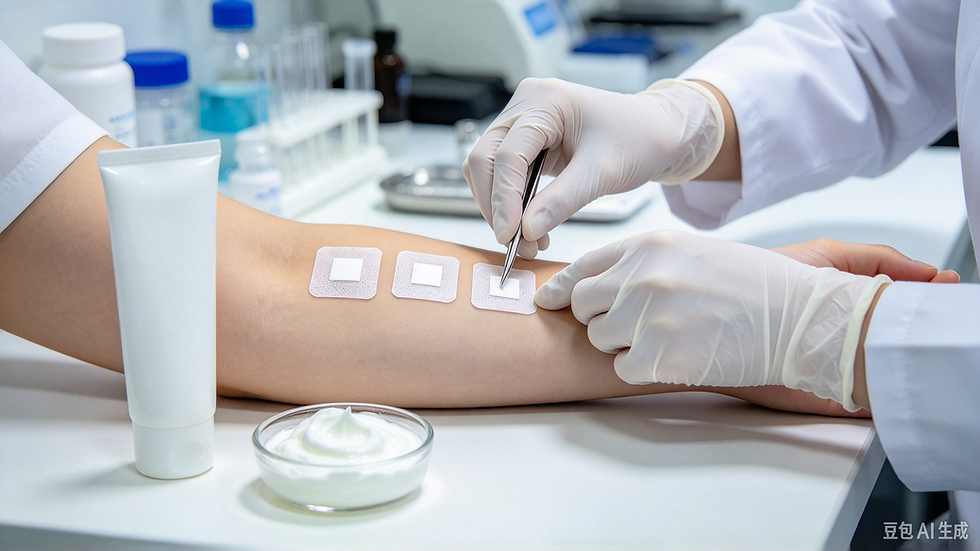
No ethics committee approves an induced sensitisation test on an infant. The human data behind a hypoallergenic baby skincare claim therefore comes from adults. Proof runs from raw materials to batch records. Ingredient screening removes known sensitisers first. In vitro assays then screen the formula as marketed. A 48-hour patch test measures irritation, and an HRIPT on at least 50 adults looks for delayed allergy. The file closes with the batch records that tie the tested formula to the shipped product. This article covers what each step proves and what a buyer checks before signing.
Why Can You Not Patch Test a Baby?
Two human safety tests carry the weight in a baby care file, and neither one runs on infants. Every human dataset in that file comes from adults. The barrier is ethical rather than technical. An HRIPT teaches the immune system to react to an ingredient on purpose. No ethics committee approves that design for a subject who cannot consent.
Why ethics committees refuse the design
An HRIPT induces sensitisation in a share of subjects by design. Adults accept that risk under informed consent. Sensitisation does not reverse once it is established. An infant cannot consent to a permanent change in immune response, so the design fails at review. Diagnostic patch testing sits outside that rule. Dermatologists use it on a child who already has dermatitis to find the trigger. That is a clinical tool, not safety evidence for a new formula.
What regulators ask for instead
The EU safety report must name the intended user group. Regulation (EC) No 1223/2009 carries no separate baby product category, so the duty lands inside the safety assessment. The assessor states the age band and uses exposure figures that match it. The SCCS Notes of Guidance, 12th revision (SCCS/1647/22, adopted 15 May 2023), sets separate exposure assumptions for children. In the United States, MoCRA requires the responsible person to hold safety substantiation records for six years.
What China adds for children's products
China regulates children's cosmetics as a distinct category and puts numbers on the evidence. The National Medical Products Administration revised the human skin patch test method in Announcement No. 5 of 2026. The revision was published on 7 January 2026 and took effect on 1 July 2026. For children's sunscreen, the closed patch panel is 30 subjects. GB 7916-2026 sets the General Safety Requirements for Cosmetics. It was published on 6 August 2026 and takes effect on 1 January 2028. It caps the aerobic plate count for children's products at 100 CFU per gram or millilitre, against 1,000 for ordinary products. A hypoallergenic baby skincare brief that ignores that threshold will stall at filing.
What Makes Hypoallergenic Baby Skincare Harder to Prove Than Adult Skincare?
Infant skin differs from adult skin in four measurable ways. Each one narrows the margin a hypoallergenic baby skincare claim has to survive. Published measurements put the stratum corneum at about 30% thinner in the first months of life. Surface area to body weight is higher, so the same dose becomes a larger load. The nappy area holds product against the skin for hours. Those factors raise penetration and contact time at once.
The barrier is thinner and the acid mantle is still forming
Neonatal skin surface pH sits between 6.5 and 7.5 at birth. It moves into the adult acid mantle range of 4.5 to 5.5 within the first weeks of life. Formulations for infants over six weeks therefore target pH 5.0 to 6.0. A neutral or alkaline wash lifts skin surface pH and leaves the barrier more open to irritants. It can also change how a preservative system performs.
The nappy area changes the test question
Occlusion, urine and faeces raise skin pH and keep the formula in contact with a barrier that is still maturing. An adult forearm does not reproduce that environment. The study design has to exaggerate exposure to compensate. A panel weighted towards sensitive skin is the accepted way to close part of the gap. Clinical testing providers recommend it for products built for children.
Factor | Adult skin | Infant skin under 12 months | Effect on the claim |
Stratum corneum | Fully developed | About 30% thinner | More formula reaches living cells |
Surface area to body weight | Lower | Higher | A larger systemic load per dose |
Skin surface pH | Acid mantle of 4.5 to 5.5 | Near neutral at birth | A weaker barrier and a changed preservative performance |
Occlusion | Intermittent | Continuous under a nappy | Longer contact, so a higher sensitisation dose |
Route of exposure | Skin and eyes | Skin, mouth and eyes | Oral and ocular routes need their own assessment |
What Does a Patch Test Prove on a Baby Product?
A 48-hour human patch test on a baby product measures irritation, and nothing else. It is often the only human report a brand holds for a hypoallergenic baby skincare claim. The standard design uses 30 volunteers. The product sits under an occlusive patch for 24 hours. A trained assessor reads the site at 30 minutes, 24 hours and 48 hours. A clean result supports a mild or non-irritating claim. It carries no information about allergy, because one exposure is too short to prime the immune system.
How to read the pass line
China's revised method sets the bar in numbers rather than adjectives. For children's sunscreen, the panel is 30 subjects. A grade 1 doubtful reaction is allowed in at most one of them. No subject may show grade 2 or above. That second condition matters more than the first, because one vesicular reaction ends the study. European and US protocols use comparable panel sizes and occlusion. Readers score reactions on the ICDRG grading system.
What a single exposure cannot show
Sensitisation needs repeated contact before it becomes visible. A negative 48-hour patch test says nothing about week six of daily use. Claim files break here when a brand presents a patch test report as proof of hypoallergenicity.
How Does an Adult HRIPT Support a Baby Formula?
Fifty adult volunteers and six weeks of patching produce the only human evidence of delayed contact allergy. That evidence carries a hypoallergenic baby skincare file. The standard design applies the product under occlusion nine times over three weeks. Each patch comes off after 24 hours, and the site is read at 48 hours. A rest period of 10 to 21 days follows. One challenge then goes onto previously untreated skin, and assessors read it at 24, 48 and 72 hours.
The schedule and the pass criteria
Leave-on products go on neat, and wash-off products are usually diluted 1 to 10. A panel of 50 subjects across nine induction applications plus one challenge produces about 500 scored patches. The published validity bar is that every patch reads negative. A pass means zero sensitisation reactions and low irritation scores. A common benchmark asks for mean erythema and oedema scores below 0.1 on the Draize scale.
Why a sensitive-skin panel matters more for baby care
A standard panel of 50 covers a narrow band of reaction thresholds. A panel built from people with reactive skin widens it. Clinical testing providers advise that a substantial share of adult volunteers for child-oriented products have sensitive skin. Adult skin is standing in for skin that cannot be tested. A 50-subject sensitive-skin panel is the common commercial format.
How adult data bridges to a baby product
The bridging argument has to be written down. It is the part of a hypoallergenic baby skincare file a reviewer reads first. Four points carry it. The tested formula is the marketed formula. The assessor clears the ingredient list for the target age band. Exposure per unit area stays at or below the panel exposure. A paediatric dermatologist reviews the design and the readings. A 28-day human use test under medical supervision adds real-world tolerance data. It runs with parental consent and induces no sensitisation.
Step | Run on | Panel and schedule | What it proves |
Ingredient and annex review | Paper | Full formula and fragrance allergen breakdown | Removes known sensitisers before any test |
In vitro battery | OECD assays | TG 442C, 442D and 442E, with 442F and 442G under TG 497 | Protein binding, keratinocyte and dendritic cell activation |
48-hour patch test | Adult volunteers | 30 subjects, occlusive, read at 30 minutes, 24 and 48 hours | Irritation only |
HRIPT | Adult volunteers | 50 subjects and up, nine applications over three weeks, 10 to 21 day rest, then challenge | Delayed contact allergy, the core of a hypoallergenic baby skincare claim |
Batch records | Production | Every batch | That the tested formula is the shipped formula |
Which Ingredients Have to Come Out of a Baby Formula?
Two ingredient groups cause most claim failures, and both are decided at brief stage. The EU Technical Document on Cosmetic Claims expects known allergens and allergen precursors to be avoided outright. That applies whenever a product carries a hypoallergenic claim.
Fragrance, essential oils and the word natural
Regulation (EU) 2023/1545 expanded Annex III to 81 individually declarable fragrance allergens. Each one must appear in the ingredient list above 0.001% in leave-on products and 0.01% in rinse-off products. Products placed on the EU market from 31 July 2026 must comply. Stock already on the market may be sold until 31 July 2028. Essential oils are not a route around the list, because limonene, linalool and citral appear on it. A hypoallergenic baby skincare brief usually drops fragrance rather than defend it.
Preservatives and wet wipes
Methylisothiazolinone is barred from leave-on products. The rinse-off ceiling fell to 0.0015% under Commission Regulation (EU) 2017/1224. Baby wipes sit on the leave-on route even though they feel like a rinse-off product. Formaldehyde-releasing preservatives stay inside Annex V limits, but formaldehyde carries a skin sensitiser classification. A low-allergy positioning is easier to defend without them. Many formulators cap phenoxyethanol at 0.5% for infant products, half the 1% ceiling the EU allows for general cosmetics.
Surfactants and the tear-free question
Tear-free is a separate claim with its own evidence, and a mild surfactant alone does not prove it. Formulators shift from anionic surfactants such as sodium lauryl sulfate towards amphoteric and mild non-ionic systems. They then adjust the finished wash to match the osmolality of tear fluid. Only a result of no irritation supports a tear-free claim. Reviewers look at the reading rather than the surfactant name.
Ingredient group | Regulatory reference | Why it blocks the claim |
Fragrance allergens such as limonene, linalool and citral | Annex III of Regulation (EC) No 1223/2009, as amended by Regulation (EU) 2023/1545 | 81 substances must be declared above 0.001% in leave-on and 0.01% in rinse-off products |
Methylisothiazolinone | Annex V entry 57, Commission Regulation (EU) 2017/1224 | Not permitted in leave-on products, which includes baby wipes |
Formaldehyde-releasing preservatives | Annex V, read with the CLP classification of formaldehyde | Permitted within limits, but formaldehyde is a skin sensitiser |
Essential oils | Annex III allergen entries | Natural origin does not lower sensitisation risk |
Harsh anionic surfactants | Not restricted by concentration | They raise irritation and water loss |
Is Pediatrician Tested the Same as Hypoallergenic?
Pediatrician tested and hypoallergenic are two different statements, and one HRIPT can support both. Pediatrician tested describes who reviewed the product or the study design. Hypoallergenic describes a body of evidence about allergenicity. No market gives either phrase a legal definition, so a hypoallergenic baby skincare file carries the burden instead.
A testing provider's claim list shows the pattern. One HRIPT result supports phrasings such as non-inducer of allergic response, paediatrician reviewed, and dermatologist tested for sensitive skin. Each phrase describes the study. The same result does not support a statement that no user will ever react. The EU Technical Document on Cosmetic Claims bars wording that suggests a complete absence of risk. Measured phrasing survives review, and absolute phrasing does not.
Claim on the carton | Regulated term | What backs it | Where it fails |
Hypoallergenic | No | Ingredient review, in vitro battery, patch test, HRIPT | Absolute phrasing, and any promise that no user will react |
Pediatrician tested | No | A statement about who reviewed the study | It says nothing about allergenicity |
Dermatologist tested | No | Dermatologist oversight of the study | Same gap |
Fragrance free | No, but labelling rules bite | No added fragrance, checked against Regulation (EU) 2023/1545 | Essential oils and masking fragrance can reintroduce declarable allergens |
Tear free | Yes in China | A no-irritation ocular result | A mild surfactant alone does not prove it |
What Do Buyers Audit in a Hypoallergenic Baby Skincare File?
A baby care buyer reads six documents before signing. The patch test report is only the first. Each item answers a question the buyer cannot settle alone. It covers the formula, the screening, the human testing, the bridging rationale and the batch records.
Document | What the buyer reads for | Who holds it |
Ingredient and fragrance allergen declaration | That every sensitiser sits below the declaration threshold | Fragrance house and formulator |
In vitro sensitisation report | That the marketed formula was screened | Testing laboratory |
48-hour patch test report | That irritation was measured under occlusion | Testing laboratory |
HRIPT report | Panel size, schedule, readings and sensitisation count | Testing laboratory |
Bridging rationale and safety assessment | Why adult data covers the target age band | Safety assessor |
Batch and process control records | That the tested formula is the shipped formula | Manufacturer |
The last item decides whether the others keep their value. Retailer clean-ingredient programmes and third-party marks have pushed the same list into commercial decisions. Marks such as the National Eczema Association seal and EWG Verified carry weight with buyers. A retailer that carries a failing baby product carries the reputational cost with it.
How Does Batch Control Keep the Claim Valid?
One test result describes one batch, so a hypoallergenic baby skincare claim is only as durable as the process behind it. Two controls carry most of the weight. Fragrance and raw material disclosure comes first. A formula cannot be cleared against Annex III until the fragrance house supplies a complete allergen breakdown with concentrations. A manufacturer that cannot obtain that data ships an unverified label. Batch consistency comes second. Water quality, emulsification temperature and filling conditions decide whether the sold formula matches the tested one.
DEVA Skincare runs those controls across four plants. The plants hold 100,000-grade GMPC cleanrooms, and the core laboratory is built to CNAS standards. The quality system covers 72 inspection and process control steps. The test menu holds 150 efficacy and safety protocols. The list includes cell efficacy and toxicity, the CAM irritation test, melanin inhibition and preservative challenge testing. Six laboratories cover cell testing, efficacy evaluation and ingredient analysis. VISIA imaging scores 12 skin indicators. Other benches handle plant extraction, packaging tests with xenon arc ageing, and heavy metal detection. More than 30 R&D engineers work from a library of 5,000 formulas. The company holds 70 granted patents with 17 more under examination. Two platforms are built for mild UV products, Sensi-Tech UV Armor for Sensitive Skin and Dual-Phase Zinc Locking Technology.
Baby care puts that system under its hardest test. DEVA produces an infant mineral sunscreen and an amino acid foam cleanser at 13 million units a year each. One of its baby care partners was certified by Euromonitor in 2024 as the leading baby sunscreen brand in Asia. That result belongs to the brand rather than to the factory.
Timelines shape the launch plan. Sampling takes one week. Mass production takes six weeks after sample approval. Each test block runs about four weeks. The menu covers in vitro panels, 28-day human use trials, TEWL with texture imaging, and SPF with water resistance. Minimum order quantities start at 5,000 units for standard formats. Aluminium cans start at 10,000, sheet masks at 50,000 and ampoules at 200,000. Building the test plan at brief stage avoids a second reformulation round.
You are developing a baby lotion, baby wash, nappy cream or mineral baby sunscreen. Send your brief through the enquiry form on this page. We will map the test plan to your formula, your target age band and your launch date. We will also show where the hypoallergenic baby skincare claim needs softer wording.
Can you run an HRIPT on a baby?
No. An HRIPT induces sensitisation on purpose, and ethics committees do not approve that design for infants who cannot consent to a permanent immune change. The human data in a baby care file comes from adult panels with a sensitive-skin share, plus a bridging rationale that a safety assessor signs.
How do you prove a hypoallergenic baby skincare claim without testing babies?
Build the file in four layers. Clear every raw material against known sensitisers and the annexes. Run in vitro sensitisation assays on the formula as marketed. Run a 48-hour patch test for irritation and an HRIPT on at least 50 adults for delayed allergy. Then hold the batch records that tie the tested formula to the shipped product.
How many volunteers does an HRIPT for a baby care product need?
Fifty subjects is the standard panel, and the published validity bar is that all 500 patches read negative. Clinical providers offer sensitive-skin panels at the same size, which is the format most useful for baby care, because adult skin stands in for skin that cannot be tested.
Is pediatrician tested the same as hypoallergenic?
No. Pediatrician tested says who reviewed the product or the study design. Hypoallergenic says something about allergenicity evidence. Neither phrase has a legal definition in the United States or the European Union, and a single HRIPT supports both, so the two often appear together on a carton.
Which fragrance allergens must be declared on a baby product label?
Regulation (EU) 2023/1545 brought the Annex III list to 81 individually declarable fragrance allergens. Each must appear in the ingredient list above 0.001% in leave-on products and 0.01% in rinse-off products. Products placed on the EU market from 31 July 2026 must comply, and existing stock may be sold until 31 July 2028.
What is the difference between a patch test and an HRIPT?
A patch test applies the product once, usually under occlusion for 24 hours, and measures irritation. An HRIPT applies it nine times over three weeks, rests the skin for 10 to 21 days, then challenges it again to detect delayed allergy. Only the HRIPT supports a hypoallergenic claim.
How long does it take to substantiate a hypoallergenic baby skincare claim?
Plan for about six weeks for the HRIPT plus one to two weeks for reporting. Each test block, from in vitro panels to SPF and water resistance, takes about four weeks. Sampling runs one week and mass production runs six weeks after sample approval, so the test calendar sets the launch date.
Comments