Is Hypoallergenic a Regulated Term in the US and the EU

Hypoallergenic is unregulated in the United States and only partly guided in the European Union. In both markets the word describes a manufacturer's intent, not a certified property.
What the FDA says today
The FDA states that no federal standards or definitions govern the use of the term. Manufacturers do not have to submit substantiation of a hypoallergenic claim. The agency tried to change that. It proposed a rule in 1974 and published a final version in 1975, which entered the Code of Federal Regulations at 21 CFR 700.100. Almay and Clinique challenged the rule, and the US Court of Appeals for the District of Columbia found it invalid. It was removed from the CFR. The FDA now says the term means whatever a particular company wants it to mean, and that no cosmetic can be guaranteed never to produce an allergic reaction. One obligation did arrive with the Modernization of Cosmetics Regulation Act, enacted in December 2022. The responsible person must hold records of adequate safety substantiation, keep them for six years, and produce them on FDA request. That duty covers product safety, not the wording of the claim.
Where the EU sets a higher bar
EU law does not define hypoallergenic either, but it sets an evidence standard. Article 20 of Regulation (EC) No 1223/2009 bans any claim that attributes a characteristic the product does not have. Commission Regulation (EU) No 655/2013 then lays down six common criteria for claim justification, and it applies from 11 July 2013. The European Commission Technical Document on Cosmetic Claims of 2017 addresses hypoallergenic in its Annex IV. Three conditions follow. The product must be designed to reduce allergenic potential. The responsible person must hold well-designed and statistically reliable data on a very low allergenic potential. Known allergens and allergen precursors must be avoided. The document also bars wording that suggests a complete absence of risk. Evidence belongs in the Product Information File under Article 11, and it must be ready before the product reaches the market.
What China and MoCRA add
China's Measures for the Administration of Cosmetic Labelling took effect on 1 May 2022. The measures ban false, exaggerated and absolute wording, and they ban any assertion or guarantee of efficacy or safety. A hypoallergenic claim with no data falls inside that prohibition. The United States applies a separate standard through the FTC. A claim must rest on competent and reliable scientific evidence, meaning studies that qualified experts accept as accurate and reliable. The FDA also has a fragrance allergen labelling rule pending under MoCRA, so US disclosure rules will tighten.
Market | Legal definition | Evidence expected | Where the evidence lives |
United States | None. No federal standard or definition | Not required by the FDA. The FTC expects competent and reliable scientific evidence if the claim is challenged | Company records, retained six years and producible on FDA request under MoCRA |
European Union | Not defined in Regulation (EC) No 1223/2009 | Very low allergenic potential supported by statistically reliable data, with known allergens avoided | Product Information File, Regulation (EC) No 1223/2009 Article 11 |
China | Not defined | Absolute and guaranteed wording is prohibited. Claim support must be verifiable | Product claim records, filed with the national regulator |
What Is the Difference Between Irritation and Skin Sensitisation?
Irritation and sensitisation are different biological events, and a formula can pass one while failing the other. Confusing the two is the most common reason a hypoallergenic claim collapses in review.
Irritation is dose-dependent and immediate
Irritation is direct tissue damage. It tracks concentration, pH and contact time. It appears within minutes to hours and usually settles once the product is removed. The immune system is not involved, so any user can develop it at a high enough dose.
Sensitisation is immune-mediated and delayed
Sensitisation is a type IV delayed hypersensitivity reaction. Early exposures teach the immune system to recognise an ingredient, and nothing visible happens at that stage. A later exposure triggers the reaction, often 24 to 72 hours after contact. Sensitisation depends on the individual rather than the dose, and it persists once established.
Feature | Irritation | Sensitisation |
Mechanism | Direct cell damage | Type IV delayed hypersensitivity |
Onset | Minutes to hours after contact | 24 to 72 hours after re-exposure |
Dose relationship | Strongly dose-dependent | Individual-dependent. No proven safe threshold for an already sensitised person |
First exposure | Can react immediately | No visible reaction while the immune system is primed |
Reversibility | Usually resolves after removal | Permanent once established |
Test that detects it | Human patch test and in vitro irritation models | HRIPT and the in vitro sensitisation battery |
What Evidence Does a Hypoallergenic Claim Actually Need?
A hypoallergenic claim needs evidence at three levels. Every raw material must be cleared, the finished formula must be tested, and the marketed product must be watched after launch. No single test settles it.
The evidence hierarchy
Ingredient review comes first. Screen the formula against Annex III of Regulation (EC) No 1223/2009, against sensitisers classified under the CLP Regulation, and against published SCCS opinions. The in vitro sensitisation battery comes next, run on the formula as marketed. A human patch test then checks irritation, and the HRIPT looks for delayed allergy. Post-market surveillance closes the loop, and the Technical Document on Cosmetic Claims asks for that assessment to be refreshed as new data arrives.
Why consumer perception data does not count
Consumer panels measure how people describe a product, not how their immune systems respond. A survey can show that users found a cream pleasant. It cannot show that sensitisation did not occur. The EU criteria require evidence that relates to the benefit claimed and comes from a valid, reproducible method. The FTC applies a similar test in the US. Use perception data for a sensory claim, and keep it out of the safety file.
How Does an HRIPT Work, and What Counts as a Pass?
The Human Repeat Insult Patch Test is the standard human study for delayed contact allergy. It compresses months of normal use into roughly six weeks by repeatedly challenging the skin, withdrawing the product, then challenging it again.
Induction phase
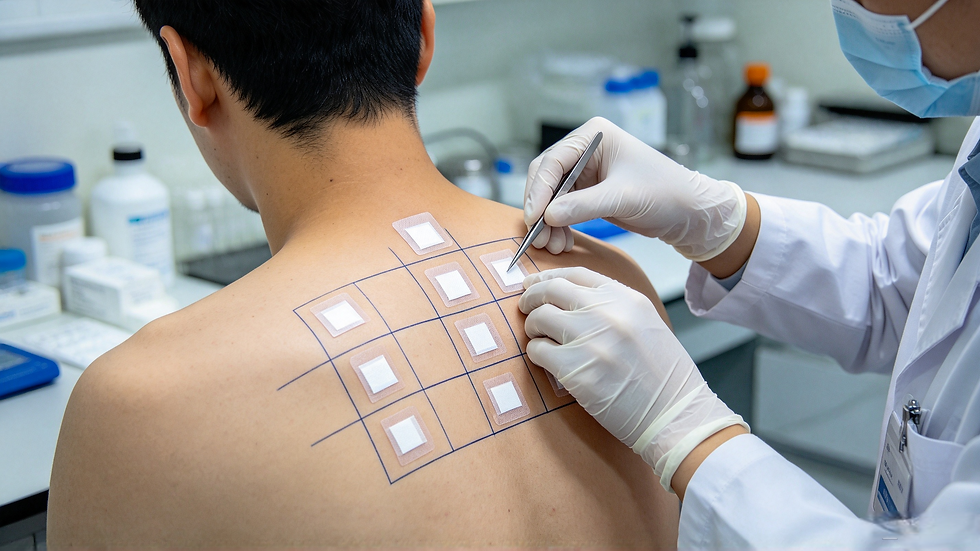
A panel of at least 50 subjects is recruited, and some protocols run to 100 or 200. A small dose of the product sits under an occlusive or semi-occlusive patch on the upper back. The patch stays for 24 hours, and a trained assessor reads the site at 48 hours. The same site receives the product nine times in a row, usually three applications a week for three weeks. Fifty subjects across nine induction applications plus one challenge produce about 500 scored patches. The published validity bar is that every patch reads negative for a positive response.
Rest and challenge phases
Application stops for 10 to 21 days. The rest period lets immune priming complete. A fresh patch then goes onto a previously untreated site, and assessors read it at 24, 48 and 72 hours against the ICDRG scale. A reaction that appears only at challenge, and not during induction, points to sensitisation.
What a pass looks like
A pass means zero sensitisation reactions at challenge and low irritation scores. A common industry benchmark uses the Draize scale and asks for mean erythema and oedema scores below 0.1 at every reading. An HRIPT is a human study, so ethics review, informed consent and Good Clinical Practice apply. Regulators treat the result as supportive evidence rather than a stand-alone approval, and that shapes how a safety assessor builds the file.
HRIPT parameter | Common acceptance criterion | What it supports |
Panel size | At least 50 subjects. Larger and sensitive-skin panels strengthen the file | Statistical reliability |
Induction schedule | Nine applications over three weeks, each read at 48 hours | Exposure that mimics repeated consumer use |
Rest period | 10 to 21 days | Allows immune priming to complete |
Challenge reading | 24, 48 and 72 hours, scored on the ICDRG scale | Detection of delayed allergy |
Sensitisation reactions | 0 | The core of the hypoallergenic claim |
Mean erythema and oedema score | Below 0.1 on the Draize scale | Low irritation |
Ethics and documentation | Ethics review, informed consent, Good Clinical Practice | Defensibility in front of an authority |
Does a 48-Hour Patch Test Replace an HRIPT?
No. A 48-hour patch test measures irritation, and it cannot detect delayed allergy because it never allows the immune system to be primed. The two tests answer different questions, and a complete file usually holds both.
What a patch test does prove
A predictive human patch test uses at least 30 volunteers, with no less than one third of either sex. The product sits under an occlusive patch and an assessor scores the site at 24, 48 and 72 hours. A clean result supports a non-irritating claim and gives an early read on tolerability. It is quick and inexpensive, so it works well as a screen before a full HRIPT.
What a patch test cannot prove
A single 48-hour exposure cannot induce sensitisation, so a negative result says nothing about allergy. Diagnostic patch testing is a separate procedure and a frequent source of confusion. Dermatologists use it on patients who are already sensitised, to find which ingredient triggers their dermatitis. That is a clinical tool, not a safety test for a new formula. Neither version of the test substitutes for an HRIPT.
Which In Vitro Tests Come Before Human Testing?
In chemico and in vitro methods screen sensitisers before any volunteer is exposed. They are cheaper to fail and faster to run, and the EU expects them because animal testing for cosmetics is banned.
The OECD Test Guidelines map onto the key events of the skin sensitisation adverse outcome pathway. OECD TG 442C covers the Direct Peptide Reactivity Assay, which measures covalent protein binding. OECD TG 442D covers KeratinoSens, which measures keratinocyte activation through the Nrf2 pathway. OECD TG 442E covers the human Cell Line Activation Test, which measures dendritic cell activation. Two further validated methods, U-SENS under TG 442F and GARDskin under TG 442G, can substitute inside a defined approach. OECD TG 497 sets out how their results are combined and scored. The SCCS Notes of Guidance, 12th revision (SCCS/1647/22, adopted 15 May 2023), expects a battery of at least three mechanistically complementary methods, because no single assay covers the whole pathway. Animal-based sensitisation tests such as the Local Lymph Node Assay sit outside the cosmetic framework in the EU, following the testing and marketing bans in Article 18 of Regulation (EC) No 1223/2009.
DEVA Skincare runs cell-based efficacy and toxicity assays and the CAM irritation test inside a 150-protocol efficacy and safety program. That program screens a formula before human testing starts.
Which Ingredients Have to Be Excluded?
A hypoallergenic claim fails on the ingredient list long before it reaches the lab. The EU Technical Document on Cosmetic Claims asks for known allergens and allergen precursors to be avoided outright.
Fragrance is the first target. Regulation (EU) 2023/1545 expanded Annex III to 81 individually declarable fragrance allergens. The declaration threshold is 0.001% in leave-on products and 0.01% in rinse-off products. Products placed on the EU market from 31 July 2026 must comply, and stock already on the market may be sold until 31 July 2028. Essential oils carry the same risk as synthetic fragrance, because limonene, linalool and citral appear on that list.
Preservatives are the second target. Methylisothiazolinone is barred from leave-on products, and its rinse-off ceiling fell to 0.0015% under Commission Regulation (EU) 2017/1224. The methylchloroisothiazolinone and methylisothiazolinone mixture is restricted to rinse-off use at 0.0015%, and the two entries are mutually exclusive. Formaldehyde-releasing preservatives such as DMDM hydantoin remain inside Annex V limits, yet formaldehyde is classified as a skin sensitiser and the whole group is best avoided under a low-allergy positioning.
Ingredient group | Why it blocks the claim | |
Declarable fragrance allergens, including limonene, linalool and citral | Annex III of Regulation (EC) No 1223/2009, as amended by Regulation (EU) 2023/1545 | 81 substances must be declared above 0.001% in leave-on and 0.01% in rinse-off products, and each one is a known sensitiser |
Methylisothiazolinone | Annex V entry 57, Commission Regulation (EU) 2017/1224 | Not permitted in leave-on products. Rinse-off ceiling 0.0015% |
MCI and MI mixture | Annex V entry 39, Commission Regulation (EU) No 1003/2014 | Rinse-off only at 0.0015%, and incompatible with methylisothiazolinone used alone |
Formaldehyde-releasing preservatives | Annex V, read with the CLP classification of formaldehyde | Permitted within limits, but formaldehyde is a recognised skin sensitiser |
Essential oils and aromatic botanicals | Annex III allergen entries | Natural origin does not lower sensitisation risk |
Why Does Process Control Decide Whether the Claim Holds?
A hypoallergenic claim rests on one formula, made the same way in every batch. A test result loses its meaning when production drifts away from the tested version.
Two controls carry most of the weight. Fragrance and raw material disclosure comes first. A finished formula cannot be cleared against Annex III until the fragrance house supplies a complete allergen breakdown with concentrations. A manufacturer that cannot obtain that data will ship an unverified label. Batch consistency comes second. Temperature control, emulsification parameters and filling conditions decide whether the tested formula and the sold formula are the same product.
DEVA Skincare operates these controls across four plants with 100,000-grade GMPC cleanrooms and a core laboratory built to CNAS standards. The quality system covers 72 inspection and process control steps, and the test menu holds 150 efficacy and safety protocols. That scope includes cell efficacy and toxicity, CAM irritation, melanin inhibition and preservative challenge testing. Six laboratories cover cell testing, product efficacy evaluation with VISIA imaging, plant extraction and fermentation, active ingredient analysis by HPLC, GC and UV-Vis, packaging testing with xenon arc ageing, and heavy metal detection. More than 30 R&D engineers work from a library of 5,000 formulas, and the company holds 70 granted patents with 17 more under examination. For sensitive-skin development the relevant platforms are Sensi-Tech UV Armor for Sensitive Skin and Dual-Phase Zinc Locking Technology, both built for UV products that have to stay mild.
Timelines shape a launch plan. Sampling takes one week, and mass production takes six weeks after sample approval. Each test block runs about four weeks, covering in vitro panels, 28-day human use trials, residue quantification, TEWL and texture imaging, multi-active compatibility, formula and stability, and SPF with water resistance. Minimum order quantities start at 5,000 units for standard formats, 10,000 for aluminium cans, 50,000 for sheet masks and 200,000 for ampoules. A hypoallergenic claim is filed as a dossier beside the safety assessment, so building the test plan at brief stage avoids a second reformulation round.
If you are developing a sensitive-skin, baby care or sunscreen line and need HRIPT-grade data behind the claim, send your brief through the enquiry form on this page. We will map the test plan to your formula, your target markets and your launch date.
Is hypoallergenic a regulated term in the United States?
No. The FDA states that no federal standards or definitions govern the term, and it has held that position since a 1975 rule was struck down by the US Court of Appeals for the District of Columbia. Manufacturers do not have to submit substantiation. The word carries no legal meaning unless a brand defines it and proves it.
Can a brand label a product hypoallergenic without testing it?
In the United States, yes. The FDA does not require testing before a hypoallergenic claim goes on a label. The European Union takes a different line. The Technical Document on Cosmetic Claims expects statistically reliable data on a very low allergenic potential, filed in the Product Information File. Retail buyers now ask for that data in every market.
How many volunteers does an HRIPT need?
At least 50 subjects form the standard panel, and published protocols often run to 100 or 200. Fifty subjects across nine induction applications plus one challenge produce about 500 scored patches. Larger panels and sensitive-skin panels build a stronger file, because they widen the range of skin types and reaction thresholds tested.
Does a negative HRIPT guarantee that a product cannot cause an allergy?
No. A negative HRIPT shows a very low sensitisation risk under the tested conditions. Individual immune systems vary, and a damaged skin barrier can change how a person responds. The EU Technical Document on Cosmetic Claims states that a hypoallergenic claim must not suggest a complete absence of risk. Keep the wording measured.
What is the difference between a patch test and an HRIPT?
A patch test applies the product once, usually for 48 hours, and measures irritation. An HRIPT applies it nine times over three weeks, rests the skin, then challenges it again to detect delayed allergy. A clean patch test supports a non-irritating claim. Only the HRIPT addresses sensitisation.
How long does an HRIPT take to complete?
Plan for about six weeks. Induction runs three weeks with nine applications, each read 48 hours after patching. A rest period of 10 to 21 days follows. Challenge and its 24, 48 and 72-hour readings take the final week. Reporting adds a further one to two weeks.
Which fragrance allergens must be declared on a cosmetic label?
Regulation (EU) 2023/1545 brought the Annex III list to 81 individually declarable fragrance allergens. Each one must appear in the ingredient list above 0.001% in leave-on products and 0.01% in rinse-off products. Products placed on the EU market from 31 July 2026 must comply, and existing stock may be sold until 31 July 2028.
Comments